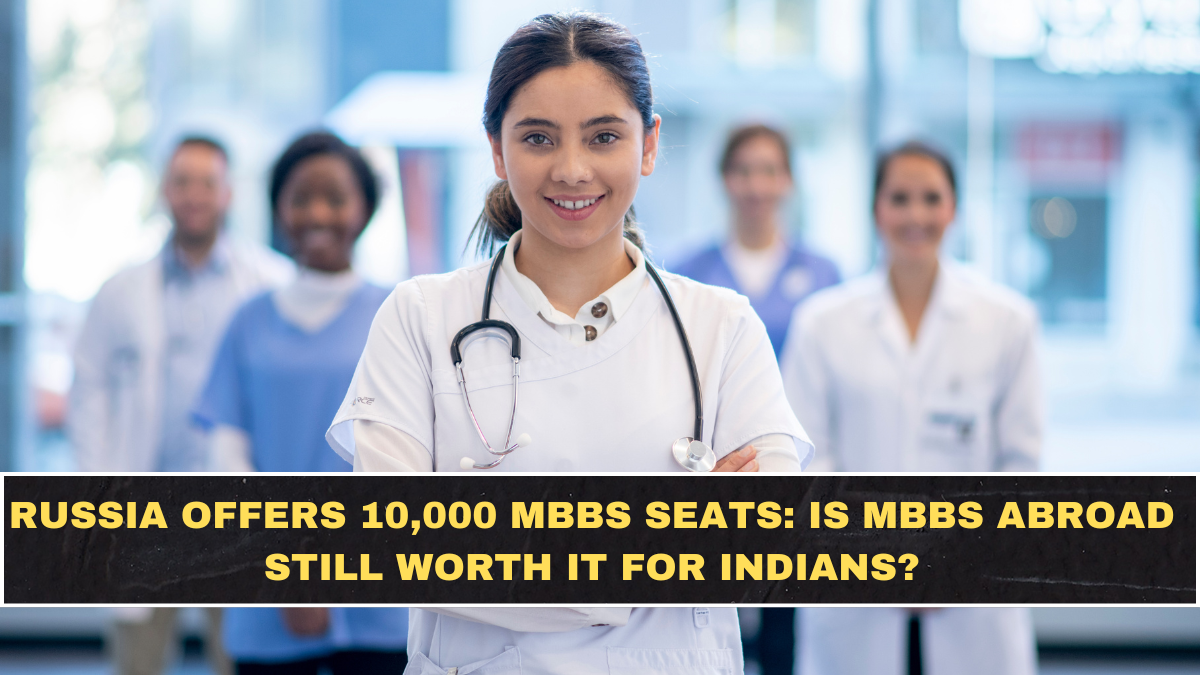
Russia is again attracting Indian medical aspirants after the All India Russian Education Fair 2026–27 opened with around 10,000 MBBS seats on offer for Indian students. The fair is being held in Chennai on May 9–10, followed by Madurai, Trichy, Salem and Coimbatore, with eight Russian universities participating. Reports say students who cleared NEET with at least 50% marks, or 40% for reserved categories, can apply, while IELTS and CET are not required.
The headline sounds exciting, especially for students who could not secure an Indian government medical seat. But families need to stop treating “MBBS abroad” as an easy shortcut. A Russian medical degree can be useful, but only if the university, course duration, internship, language, clinical exposure and Indian licensing rules are checked properly before admission.
Why Are Indian Students Looking At Russia?
The biggest reason is cost and seat pressure. In India, government MBBS seats are highly competitive, while many private medical colleges are financially impossible for middle-class families. Russian universities are being promoted as more affordable, with reports saying annual fees can start around ₹3.5 lakh because of subsidies. Over 200 students may also receive full scholarships through the fair route.
| Factor | Russia MBBS Appeal |
|---|---|
| Seats Offered | Around 10,000 |
| Eligibility | NEET-qualified students |
| Entrance Tests | No IELTS or CET required, as reported |
| Fees | Starting around ₹3.5 lakh per year |
| Scholarships | 200+ full scholarships expected |
| Fair Cities | Chennai, Madurai, Trichy, Salem, Coimbatore |
| Key Risk | NMC compliance and future licensing |
What Should Students Check First?
The first thing students must check is whether the course matches India’s National Medical Commission rules for foreign medical graduates. NMC’s Foreign Medical Graduate Licentiate Regulations require a foreign medical degree course of at least 54 months, followed by at least 12 months of internship in the same foreign medical institution. The medium of instruction must also be English, and the student must be eligible for registration in the country where the degree is awarded.
This is where many students get trapped by agents. They listen to “low fees” and “easy admission” but ignore the rulebook that decides whether they can practise in India later. If the course is not compliant, the degree can become a very expensive mistake. Do not trust brochures blindly; verify the university, course structure, hospital training and licensing pathway yourself.
Is MBBS Abroad A Good NEET Alternative?
MBBS abroad can be an option, but calling it a simple NEET alternative is misleading. Students still need NEET qualification to pursue medical education abroad if they want recognition in India. After completing the foreign degree, they must clear the required Indian licensing pathway, including FMGE or the applicable exam framework at that time, before practising in India.
The smart way to judge MBBS abroad is:
- Check if the university is properly recognised in its own country.
- Confirm the full course duration and internship structure.
- Make sure the medium of instruction is genuinely English.
- Speak to current Indian students, not only agents.
- Understand climate, language, food and safety realities.
- Prepare early for India’s licensing exam, not after graduation.
What Are The Real Risks Of Studying MBBS In Russia?
The biggest risks are not only academic. Students may face language barriers in hospitals, cold weather, cultural adjustment, documentation problems, clinical exposure gaps and licensing stress after returning to India. Even if classroom teaching is in English, patient interaction in hospitals may involve Russian, which can affect clinical learning if the student does not adapt.
Another risk is war, sanctions and geopolitical uncertainty. Russia remains a major education destination, but families should still consider travel, banking, safety, visa and international payment issues before committing. Ignoring these risks because the fee looks attractive is careless. Medical education is a six-year decision, not a shopping discount.
Who Should Consider Russian MBBS?
Russian MBBS may suit students who are genuinely committed to medicine, ready to live abroad, disciplined enough to study consistently and willing to prepare for Indian licensing exams from the beginning. It may also suit families who cannot afford Indian private medical colleges but can still handle foreign living costs, travel and long-term uncertainty.
It is not suitable for students who want an easy route, weak academic preparation or a guaranteed doctor title without struggle. Medicine is difficult everywhere. If a student barely studies after admission, Russia will not magically create a successful doctor. The country can provide a pathway, but the student still has to earn the outcome.
Conclusion: Is Russia’s 10,000 MBBS Seat Offer A Lifeline Or A Trap?
Russia’s 10,000 MBBS seat offer can be a lifeline for serious Indian students who missed an Indian medical seat but still have the discipline and financial planning to study abroad properly. The lower fee structure, NEET-based eligibility and scholarship possibilities make the opportunity attractive, especially for middle-class families. For the right student, it can open a real medical career pathway.
But this is not a decision to take emotionally after seeing a fair advertisement. Families must verify NMC compliance, internship rules, language, clinical training, university reputation, living costs and return-to-India licensing requirements. A foreign MBBS degree can build a career, but a poorly researched admission can ruin years and lakhs of rupees.
FAQs
Is NEET Required For MBBS In Russia?
Yes, Indian students need to qualify NEET if they want to study MBBS abroad and later seek eligibility to practise in India. Reports around the Russian Education Fair say NEET-cleared students with 50% marks, or 40% for reserved categories, can apply for the offered seats. Students should still verify eligibility directly with official admission and NMC-linked requirements.
How Many MBBS Seats Is Russia Offering Indian Students?
The All India Russian Education Fair 2026–27 is offering around 10,000 MBBS seats for Indian students through participating Russian universities. The fair is starting in Chennai and will then move to other Tamil Nadu cities. Reports also mention scholarship opportunities for more than 200 students.
Is A Russian MBBS Degree Valid In India?
A Russian MBBS degree can be valid for India only if it meets NMC requirements and the student clears the required licensing pathway in India. NMC rules require minimum course duration, internship, English-medium education and proper eligibility to practise in the country of study. Students should never assume validity without checking the exact university and course structure.
Is MBBS In Russia Better Than Private MBBS In India?
It depends on the student’s budget, academic discipline, university choice and career plan. Russia may be cheaper than many Indian private colleges, but it comes with language, climate, licensing and adjustment challenges. A good Indian seat is usually simpler for practising in India, while Russia can work only if the student handles the foreign pathway seriously.