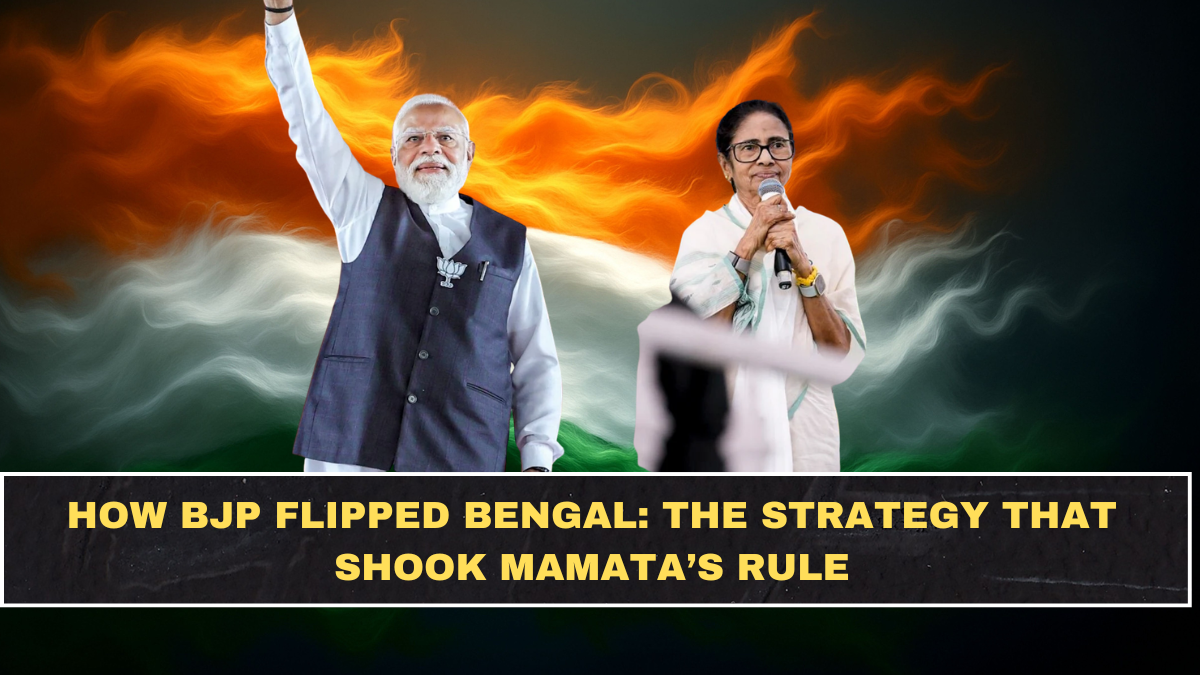
BJP’s Bengal victory has become one of the biggest political stories of 2026 because it ended Trinamool Congress’s long rule in a state once seen as extremely difficult for the party to conquer. Reuters reported that BJP won more than two-thirds of the 294-seat Assembly, while TMC fell sharply from 215 seats to 80. That is not a routine anti-incumbency result; it is a complete power shift.
NDTV’s live result report said BJP won 207 seats, while TMC was reduced to 80, confirming that the saffron party crossed the majority mark comfortably. The shock became even bigger because Mamata Banerjee herself lost her constituency, turning BJP’s win into both a numerical and symbolic victory. For Bengal politics, this is the kind of result that resets every old assumption.

What Do The Bengal Numbers Reveal?
The result shows that BJP did not just improve its performance; it converted years of organisational work into a decisive mandate. TMC still remains a major party, but its fall from a dominant ruling force to a sharply reduced opposition shows how deeply the voter mood shifted. The numbers also prove that Bengal was not simply a close fight that BJP narrowly won.
| Party/Point | 2026 Position | Why It Matters |
|---|---|---|
| BJP | 207 seats | Clear majority and historic first government |
| TMC | 80 seats | Sharp fall from previous dominance |
| Assembly Strength | 294 seats | BJP crossed majority easily |
| Mamata Banerjee | Lost seat | Huge symbolic damage |
| Political Meaning | Power shift | Bengal moves into a new phase |
This table is the real story. A party does not win over 200 seats in Bengal by accident, and a ruling party does not fall this hard because of one bad slogan. BJP appears to have built a wider coalition of anger, aspiration and identity politics, while TMC struggled to protect its old emotional hold over voters.
How Did BJP Build The Winning Formula?
BJP’s strategy worked because it attacked TMC on multiple fronts instead of depending on one issue. Reuters noted that Prime Minister Narendra Modi, Amit Shah and other senior BJP leaders campaigned heavily, focusing on illegal immigration and the state’s weak local economy under Banerjee. That gave BJP a sharp campaign frame against a long-ruling government.
Economic Times described BJP’s Bengal breakthrough as a result of strategy, structure and sentiment shift, pointing to anti-incumbency, corruption concerns, administrative changes, targeted social engineering and organisational reforms. In simple words, BJP did not only fight from the top; it built pressure at the booth level, caste-community level and narrative level together.
BJP’s winning mix looked like this:
- Strong anti-incumbency against long TMC rule
- Aggressive national leadership campaign
- Focus on immigration, economy and governance
- Better booth-level organisation in key regions
- Targeted social engineering across voter groups
- TMC’s inability to control the change narrative
Why Did TMC’s Strongholds Collapse?
TMC’s biggest weakness was that it started looking like the establishment it once fought against. After years in power, complaints around local leadership, corruption allegations, administrative fatigue and political violence became harder to dismiss. BJP used that frustration to present itself as the only force strong enough to break TMC’s control.
Times of India reported that a split in minority votes helped BJP breach several TMC bastions, which is politically important because minority consolidation had long been a major part of TMC’s electoral strength. Once BJP started gaining in areas where TMC expected protection, the result became much harder for Mamata’s party to control.
The brutal truth is that TMC may have underestimated how quickly voter loyalty can become voter fatigue. Mamata still has a strong political identity, but this election shows that identity alone cannot survive if local dissatisfaction piles up. BJP turned that dissatisfaction into a state-wide verdict.
Is BJP’s Bengal Win Bigger Than One State?
Yes, because Bengal was one of BJP’s most important unfinished political projects. Reuters described the win as BJP’s first-ever rule in West Bengal and a major milestone in eastern India. Times of India also reported BJP victories in Bengal, Assam and Puducherry, with party leaders presenting the results as public endorsement of Modi’s leadership and the “double-engine” governance model.
For BJP, Bengal is not just another state on the map. It gives the party a huge psychological boost in the east and weakens one of the strongest regional opposition faces in India. For TMC, the problem is now bigger than losing power; the party must rebuild its credibility while BJP controls the government and the political narrative.
Conclusion: Has Mamata’s Era Really Ended?
BJP’s Bengal win has clearly ended TMC’s uninterrupted hold on power, but it would be foolish to say Mamata Banerjee is politically finished. She still has a large support base and TMC remains the main opposition party with 80 seats. However, the old image of Mamata as unbeatable in Bengal has been badly damaged.
The real lesson is uncomfortable for TMC: voters did not just choose BJP; they rejected the feeling that Bengal had no alternative. BJP flipped Bengal by mixing organisation, national leadership, anti-incumbency and targeted ground strategy. If TMC wants a comeback, it cannot survive on outrage alone. It needs serious rebuilding, cleaner local leadership and a sharper reason for voters to return.
FAQs
How many seats did BJP win in West Bengal election 2026?
BJP won 207 seats in the 294-member West Bengal Assembly, according to NDTV’s result report. Reuters also reported that BJP secured more than two-thirds of the Assembly, making it a historic victory for the party in Bengal.
How many seats did TMC win in Bengal election 2026?
TMC was reduced to 80 seats in the 2026 West Bengal Assembly election. Reuters noted that this was a sharp fall from the party’s previous tally of 215 seats, showing the scale of the political setback.
Why did BJP win Bengal?
BJP won Bengal through a mix of anti-incumbency, strong national campaigning, booth-level organisation, targeted social engineering and messaging around governance, economy and immigration. Reports also pointed to a split in minority votes as one factor that hurt TMC in key areas.
Is Mamata Banerjee still politically relevant?
Yes, Mamata Banerjee remains politically relevant because TMC is still the main opposition force in Bengal. But her personal defeat and TMC’s fall to 80 seats have seriously damaged the image of invincibility that helped her dominate state politics for years.