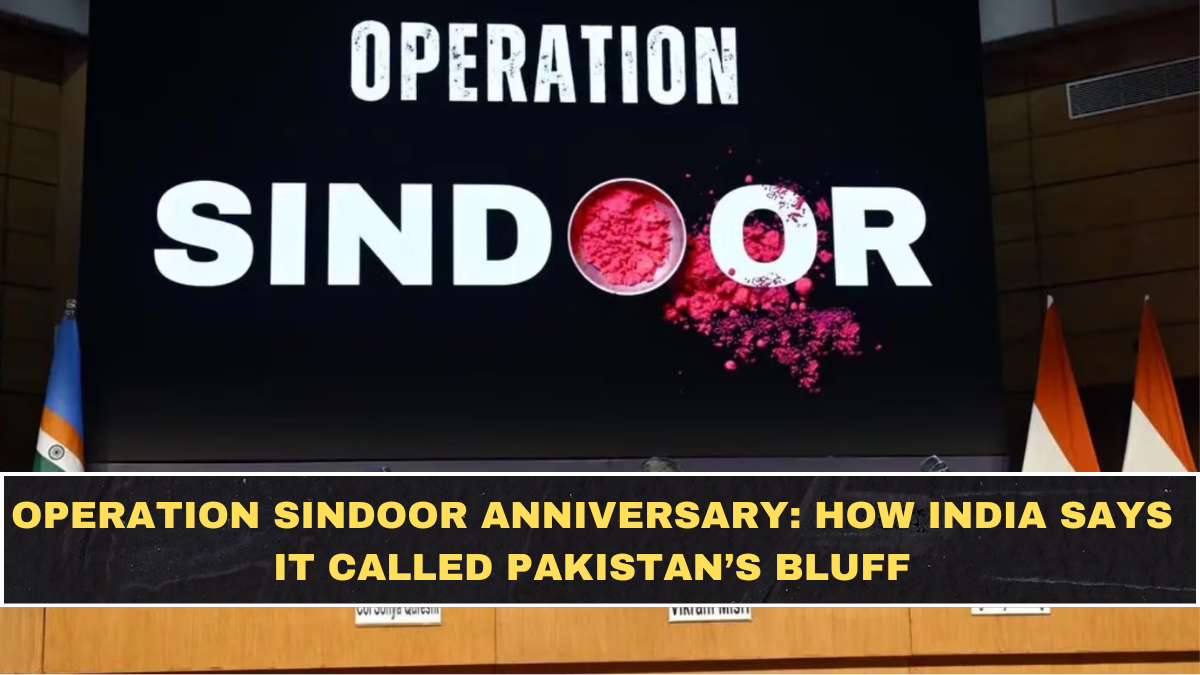
One year after Operation Sindoor, India’s military leadership has again put the focus on precision strikes, long-range weapons and a sharper counter-terror doctrine. The operation was launched on May 7, 2025, after the Pahalgam terror attack that killed 26 people, mostly tourists, in Kashmir. AP reported that India blamed Pakistan-backed militants for the attack, while Pakistan denied the allegation and called for an independent investigation.
The anniversary briefing matters because officials are framing Operation Sindoor not as a one-off strike, but as a strategic shift. The message is clear: India wants to show that terror infrastructure across the Line of Control and even deeper targets can be hit without being paralysed by Pakistan’s nuclear warnings. That is why the phrase “called Pakistan’s bluff” is dominating the discussion.
What Was Operation Sindoor About?
Operation Sindoor was described by India as a targeted campaign against terror infrastructure across the Line of Control and inside Pakistan. The Ministry of Defence had said the operation targeted nine major camps based on multi-agency intelligence and was planned to minimise collateral damage. It also said restraint was exercised to avoid civilian harm, making the operation focused rather than uncontrolled escalation.
| Key Detail | What Was Reported |
|---|---|
| Operation | Operation Sindoor |
| Date | May 7, 2025 |
| Trigger | Pahalgam terror attack |
| Indian Claim | Terror infrastructure was targeted |
| Sites Targeted | Nine major camps |
| Military Focus | Precision, coordination and deterrence |
| Anniversary Theme | Counter-terror doctrine and long-range capability |
| Pakistan Response | Drone, missile and artillery retaliation reported |
Why Is The “Pakistan Bluff” Line So Important?
The “bluff” argument is about deterrence. For years, Pakistan’s nuclear posture has been seen as a shield against deeper Indian military responses. Indian officials are now arguing that Operation Sindoor showed New Delhi could respond militarily without letting nuclear signalling freeze decision-making. Indian Express reported that at the anniversary briefing, Indian military officials described how long-range weapons helped India call Pakistan’s bluff.
This does not mean escalation risk disappears. That would be a childish reading. India and Pakistan are nuclear-armed rivals, and even a limited conflict can become dangerous if misread by either side. The smarter takeaway is that India is trying to create space for calibrated military action below the threshold of full-scale war.
What Weapons And Systems Became The Main Focus?
Indian officials highlighted indigenous and advanced systems as key parts of the operation. Economic Times reported that military officials said BrahMos, Akash and other homegrown platforms played a decisive role, while Lt Gen Rajiv Ghai said more than 65% of India’s defence equipment is now indigenously manufactured. That gives Operation Sindoor a defence-industry angle, not just a military-strategy angle.
Important systems discussed around the operation include:
- BrahMos: high-speed precision strike capability.
- Akash: surface-to-air defence support.
- Integrated air defence: response to drones and UAVs.
- Long-range weapons: deeper strike capability.
- Tri-service coordination: Army, Navy and Air Force synergy.
- Surveillance and command systems: faster threat response.
How Did Pakistan Respond?
AP reported that after India launched strikes inside Pakistan on May 7, 2025, Pakistan carried out retaliatory attacks involving drone incursions, missile strikes and artillery fire. The fighting lasted four days before a ceasefire was reached on May 10 after U.S. mediation. Pakistan later warned on the anniversary that any hostile design would be countered with greater strength and precision.
India’s official version says Pakistan’s retaliatory drone and UCAV attacks against Indian airbases and logistics infrastructure were neutralised by a multilayered air defence architecture. PIB said India’s Integrated Command and Control Strategy helped identify, assess and intercept threats across multiple domains. This is why the anniversary briefing is also being used to highlight air defence readiness.
What Changed In India’s Defence Thinking?
The biggest shift is the idea that counter-terror response may no longer stay limited to old patterns of restraint. Economic Times reported that Lt Gen Rajiv Ghai called Operation Sindoor a defining moment in India’s strategic journey and said it marked a calibrated change in the response framework. He also said the operation was “not the end” but “just the beginning,” signalling a longer-term doctrinal shift.
The brutal reality is that this doctrine raises both confidence and risk. It strengthens India’s message that terror attacks can invite direct costs. But it also means crisis management, communication and escalation control become even more important. Strong weapons without disciplined decision-making are not strategy; they are danger.
Conclusion: Why Does Operation Sindoor Still Matter?
Operation Sindoor matters because it has become a symbol of India’s changing counter-terror posture. The anniversary briefing pushed three big messages: India can strike with precision, India is investing in indigenous defence capability, and India does not want Pakistan’s nuclear signalling to block every military option. That is why the operation continues to dominate national-security debate one year later.
But this should not be turned into shallow chest-thumping. India and Pakistan remain nuclear-armed neighbours, and every military move carries real escalation risk. The serious lesson from Operation Sindoor is not just power; it is controlled power. If India wants deterrence to work, strength must remain tied to intelligence, restraint and clear political objectives.
FAQs
What Was Operation Sindoor?
Operation Sindoor was India’s military response launched on May 7, 2025, after the Pahalgam terror attack. India said the operation targeted terror infrastructure across the Line of Control and inside Pakistan. The Ministry of Defence said nine major camps were targeted based on multi-agency intelligence.
Why Is Operation Sindoor Called A Turning Point?
It is called a turning point because Indian military officials say it showed a calibrated shift in India’s counter-terror response. The operation used precision weapons, tri-service coordination and long-range capabilities. Officials also framed it as proof that Pakistan’s nuclear signalling would not permanently stop India from responding.
What Was Pakistan’s Response To Operation Sindoor?
Pakistan responded with drone incursions, missile strikes and artillery fire after India’s May 7 strikes, according to AP. The conflict lasted four days and ended with a ceasefire on May 10 after U.S. mediation. Pakistan also renewed strong warnings on the anniversary of the clash.
What Is The Biggest Lesson From Operation Sindoor?
The biggest lesson is that modern deterrence depends on precision, intelligence, air defence and escalation control. India used the anniversary to highlight long-range weapons and indigenous systems, but the real challenge is managing military strength responsibly. In a nuclear neighbourhood, power without restraint can become a bigger risk than weakness.