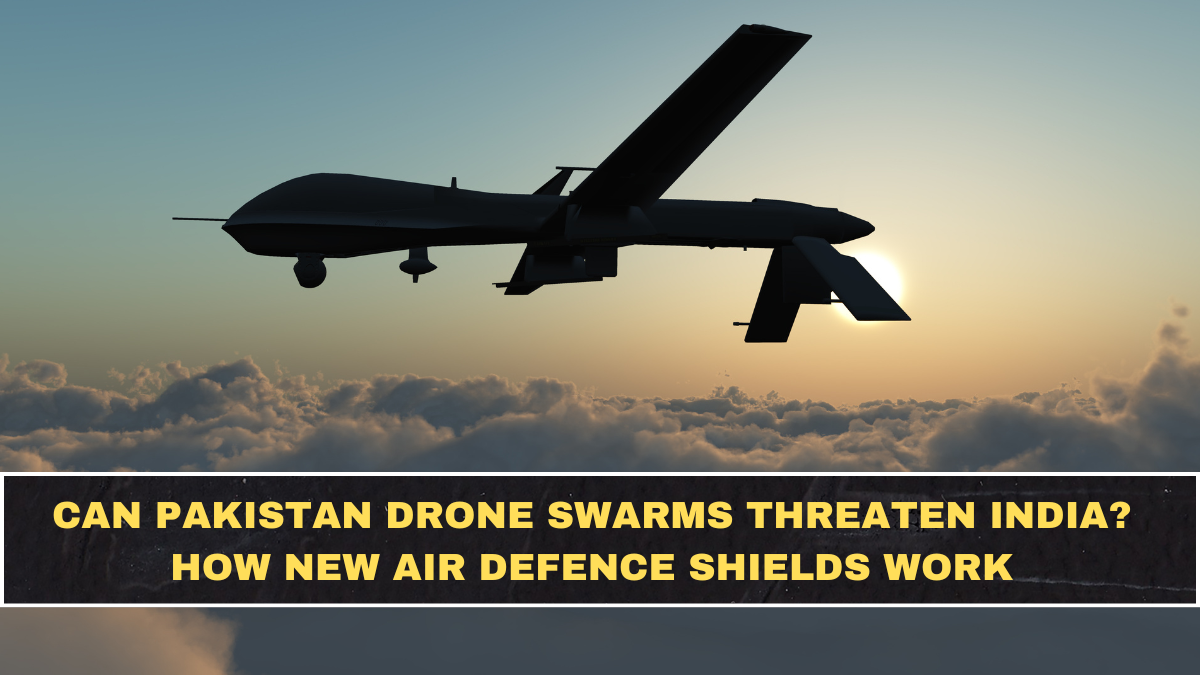
Drone swarms are no longer a science-fiction threat. They are becoming a real battlefield concern because small, low-cost drones can be launched in groups to confuse radars, stretch air-defence systems and attack military or civilian infrastructure. After Operation Sindoor, reports said Pakistan responded with waves of drones and missiles, while India relied on layers including S-400, Akash and counter-drone systems to stop incoming threats.
This is why India’s focus has shifted from only stopping aircraft and missiles to detecting, tracking and neutralising drones at scale. A single drone can be annoying, but a swarm can become dangerous because it attacks the defender’s attention, ammunition and response speed. The real challenge is not just shooting drones down; it is doing it cheaply, quickly and repeatedly.
Why Are Drone Swarms So Dangerous?
Drone swarms are dangerous because they can be cheaper than the missiles used to stop them. If an enemy sends many small drones and India responds with expensive interceptors every time, the cost balance becomes ugly. That is why modern air defence must combine missiles, guns, jammers, lasers, sensors and AI-driven command systems instead of depending on one weapon.
| Threat | Why It Matters |
|---|---|
| Small drones | Harder to detect than aircraft |
| Swarm attacks | Can overload radars and operators |
| Loitering munitions | Can wait before striking |
| Cheap drones | Create cost-pressure on expensive defence |
| AI-enabled swarms | Can coordinate movement and confuse response |
| Border launches | Reduce reaction time for defenders |
What Is Mission Sudarshan Chakra?
Mission Sudarshan Chakra is being discussed as India’s larger national air-defence shield, combining existing and future systems into a layered network. Defence Minister Rajnath Singh recently called Sudarshan air defence a strong example of AI application in military technology, showing that India wants faster detection, decision-making and response against modern aerial threats.
The idea is not just to place one big missile system and hope everything is safe. A serious shield needs radars, satellites, sensors, command centres, cyber protection, counter-drone tools and strike capability working together. If Sudarshan Chakra becomes only a slogan, it will fail. If it becomes a real integrated network, it can change India’s defensive posture.
How Does Project Kusha Fit In?
Project Kusha is India’s planned indigenous long-range surface-to-air missile system, often described as a homegrown answer to high-end air-defence needs. Economic Times reported that Bharat Electronics Limited is working on the system, with a prototype expected in 12–18 months and user trials likely to follow after that. The goal is to strengthen India’s ability to intercept aircraft, missiles and other aerial threats at longer ranges.
This matters because India cannot depend forever on imported systems like S-400. Imports are useful, but long-term security needs domestic production, domestic upgrades and domestic control over supply chains. Project Kusha can become important if it actually delivers performance, timelines and integration instead of becoming another delayed defence promise.
What Systems Can Stop Drone Swarms?
India’s future defence will need multiple layers because no single system can stop every drone. DRDO successfully tested its Integrated Air Defence Weapon System in August 2025, including QRSAM, Advanced VSHORADS and a high-power laser-based Directed Energy Weapon. The test targeted high-speed fixed-wing UAVs and a multicopter drone, showing the kind of layered response needed for future threats.
Key tools India may need include:
- Long-range systems like S-400 and Project Kusha for bigger threats.
- Akash and QRSAM-type systems for medium and quick-reaction defence.
- VSHORADS for short-range protection.
- Jammers and spoofers to disrupt drone control links.
- Directed energy weapons for cheaper drone kills.
- AI-based command networks to detect and prioritise threats faster.
Can Pakistan Overwhelm India’s Air Defence?
Pakistan can create pressure with drones, but overwhelming India’s air defence is not as simple as social media warriors imagine. India has already built multiple layers, and Operation Sindoor-era reporting suggests incoming drone and missile threats were intercepted without major damage. But India should not become arrogant, because drone warfare evolves fast and cheap systems can create serious stress if launched in large numbers.
The real danger is not one dramatic swarm destroying everything. The bigger risk is repeated probing attacks that test gaps, exhaust resources and force India to reveal radar patterns and response tactics. That is why India must keep improving detection, electronic warfare, AI-enabled tracking and low-cost kill options. Expensive missiles alone are not a sustainable drone-defence strategy.
Conclusion: Is India Ready For Drone Swarm Warfare?
India is better prepared than before, but it cannot afford comfort. S-400, Akash, counter-drone grids, IADWS, Sudarshan Chakra and Project Kusha show that India understands the direction of future warfare. The problem is that drone threats change quickly, and the side that adapts faster usually gains the advantage.
The smartest defence is layered, automated, affordable and constantly upgraded. India must not treat drone swarms as a future problem; they are already part of modern conflict. Pakistan may not easily defeat India’s air defence, but even limited drone pressure can cause disruption if India becomes slow, overconfident or dependent on expensive interceptors for cheap threats.
FAQs?
What Is A Drone Swarm?
A drone swarm is a group of drones used together to confuse, overwhelm or attack a target. These drones may be controlled manually, semi-autonomously or through AI-supported coordination. The danger comes from numbers, speed and the difficulty of stopping many small targets at once.
What Is Project Kusha?
Project Kusha is India’s planned indigenous long-range surface-to-air missile system. It is expected to strengthen India’s ability to intercept advanced aerial threats, including aircraft and missiles. Reports say its prototype may be ready in 12–18 months, followed by user trials.
What Is Mission Sudarshan Chakra?
Mission Sudarshan Chakra is being discussed as India’s larger AI-enabled, multi-layered air-defence shield. It aims to connect sensors, air-defence systems, command networks and future weapons into one stronger protective architecture. Its success will depend on real integration, not just announcements.
Can Lasers Stop Drones?
Lasers can be useful against drones because they may offer a lower-cost way to damage or destroy small aerial targets. DRDO’s IADWS test included a high-power laser-based Directed Energy Weapon along with missile systems. However, lasers are not a complete solution and must work with radars, missiles, guns and electronic warfare.
Click here to know more