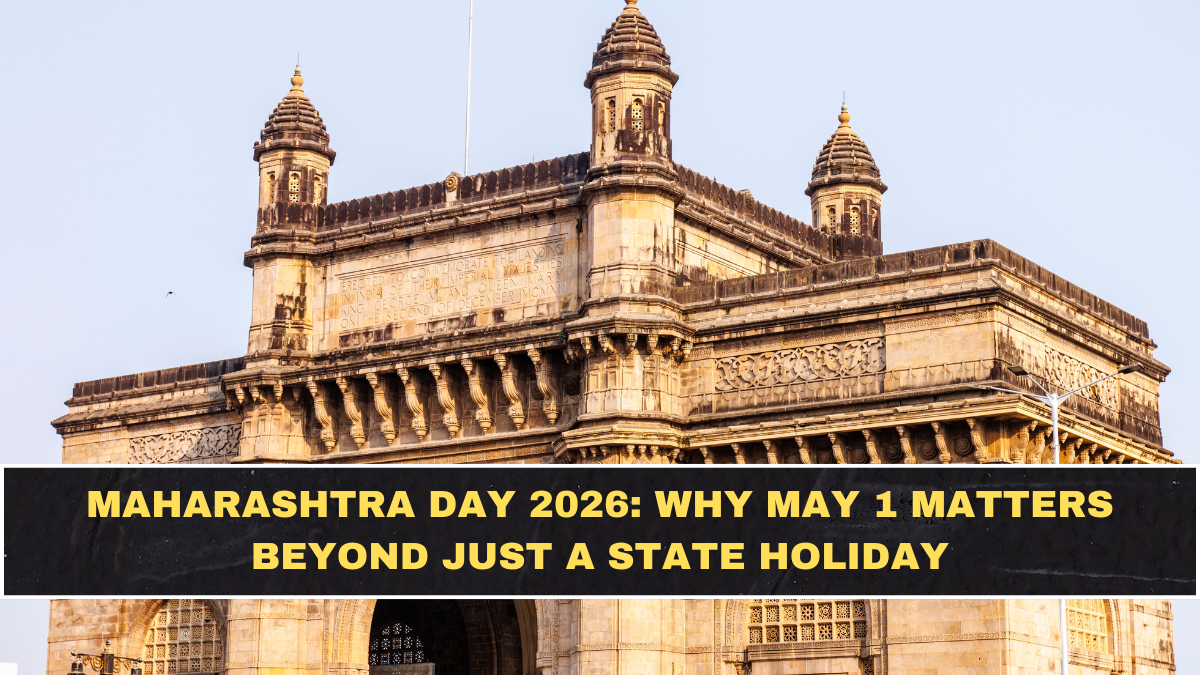
Maharashtra Day is celebrated every year on May 1 to mark the formation of the state of Maharashtra in 1960. The state was created after the old Bombay State was divided on linguistic lines, leading to the formation of Maharashtra and Gujarat. The Bombay Reorganisation Act, 1960 came into effect on May 1, which is why the date became Maharashtra Day.
This day is not only a public holiday. It is a reminder of the long demand for a Marathi-speaking state and the identity movement that shaped modern Maharashtra. For people in Mumbai, Pune, Nagpur, Nashik and across the state, May 1 carries political, cultural and emotional meaning that goes far beyond a day off.
What Is The History Behind Maharashtra Day?
The history of Maharashtra Day is linked to the Samyukta Maharashtra movement, which demanded a separate Marathi-speaking state with Mumbai as its capital. After India reorganised states largely on linguistic lines, the bilingual Bombay State became a major point of conflict because it included Marathi, Gujarati, Kutchi and Konkani-speaking regions.
The Samyukta Maharashtra Samiti led protests, marches and public mobilisation for a separate state. The movement eventually succeeded when Maharashtra and Gujarat were formed on May 1, 1960. That is why Maharashtra Day is not just an administrative anniversary; it is tied to struggle, sacrifice, language pride and regional identity.
| Key Detail | Maharashtra Day 2026 Update | Why It Matters? |
|---|---|---|
| Date | May 1, 2026 | Marks Maharashtra’s formation day |
| Formation year | 1960 | State completed 66 years |
| Legal basis | Bombay Reorganisation Act, 1960 | Divided Bombay State into Maharashtra and Gujarat |
| Main movement | Samyukta Maharashtra movement | Pushed for Marathi-speaking Maharashtra |
| Also observed as | International Workers’ Day | Adds labour-rights significance |
| 2026 timing | Friday public holiday | Creates a long weekend for many residents |
Why Does May 1 Matter Beyond A Holiday?
May 1 matters because it combines state identity, labour history and public memory. Maharashtra Day falls on the same date as International Workers’ Day, which gives the day a dual meaning. On one side, it celebrates the formation of Maharashtra. On the other, it recognises the contribution of workers to the state’s development.
This overlap is important because Maharashtra’s growth has been built by workers, farmers, traders, industrial labour, public servants, artists, entrepreneurs and migrants. Mumbai may be India’s financial capital, but its economic engine depends on millions of ordinary workers. Ignoring that would make Maharashtra Day shallow and purely symbolic.
How Is Maharashtra Day Celebrated?
Maharashtra Day is usually marked with official ceremonies, parades, speeches, cultural programmes and flag-hoisting events. Celebrations often include state-level functions, performances highlighting Marathi culture and messages from political leaders. Reports also note that parades and official ceremonies are commonly associated with the day.
In 2026, the day has also become highly visible on social media. Political leaders, public figures and celebrities have shared messages celebrating Maharashtra’s contribution to India. Chief Minister Devendra Fadnavis extended greetings and highlighted Maharashtra’s role in inclusive development, while also acknowledging labourers on Labour Day.
What Is Open And Closed On Maharashtra Day 2026?
Since Maharashtra Day is a public holiday in the state, government offices, banks, many schools and several public institutions remain closed. NDTV reported that May 1, 2026 is being observed as a public holiday, though essential services continue to function. Travellers and residents are advised to check schedules before planning official work or local movement.
This year, the date falls on a Friday, creating a long weekend for many people. Times of India reported that Maharashtra Day 2026 also overlaps with Labour Day and Buddha Purnima, making the holiday more significant and increasing travel interest. That means tourist spots, highways and city exits may see heavier movement.
Why Is Maharashtra Day Important For Mumbai?
Maharashtra Day is especially important for Mumbai because the city was at the heart of the statehood debate. The demand for a Marathi-speaking Maharashtra included Mumbai as the capital, and that issue carried deep emotional and political weight. Without understanding Mumbai’s role, the history of Maharashtra Day remains incomplete.
Today, Mumbai represents both Marathi identity and India’s global economic ambition. It is home to finance, cinema, ports, startups, media, migrants and working-class neighbourhoods. That mix makes the city powerful, but also complicated. Maharashtra Day reminds Mumbai that growth without cultural memory and worker dignity is incomplete.
Why Are Celebrities Posting About Maharashtra Day?
Celebrities post about Maharashtra Day because Maharashtra, especially Mumbai, is the centre of India’s entertainment industry. For many actors, directors, musicians and technicians, the state is not just a workplace; it is where their careers were built. That is why celebrity messages often become part of the day’s social media trend.
In 2026, Akshay Kumar’s Maharashtra Day message went viral after he called the state his “karma bhoomi.” Times of India reported that he expressed gratitude and pride, saying Maharashtra had played a major role in his personal and professional life. Celebrity posts like this increase the day’s visibility among younger and non-Marathi audiences.
What Does Maharashtra Day Mean For Young People?
For young people, Maharashtra Day should not be reduced to just wishes, WhatsApp posts and a holiday. It is a chance to understand how language, identity, politics and development shaped the state they live in. Maharashtra did not appear randomly on the map. It came through political struggle and public demand.
At the same time, young people should also look at the present. Maharashtra’s future depends on jobs, infrastructure, climate resilience, public transport, housing, education and social harmony. Pride is useful only when it pushes people to build better cities, fairer workplaces and stronger communities.
Conclusion
Maharashtra Day 2026 marks 66 years since the formation of Maharashtra on May 1, 1960. The date honours the creation of a Marathi-speaking state after the Bombay Reorganisation Act came into effect. It also remembers the Samyukta Maharashtra movement and the demand for identity, representation and cultural recognition.
But the day should not be treated as just another holiday. It is also Labour Day, which means the state’s pride must include respect for workers who built its cities, industries and economy. Maharashtra Day matters because it connects history with responsibility. Celebrating the state is easy; improving it is the real test.
FAQs
Why is Maharashtra Day celebrated on May 1?
Maharashtra Day is celebrated on May 1 because the state of Maharashtra was officially formed on that date in 1960. The Bombay Reorganisation Act divided the old Bombay State into Maharashtra and Gujarat. Since the Act came into effect on May 1, the date became Maharashtra Day.
What is the connection between Maharashtra Day and Gujarat Day?
Maharashtra Day and Gujarat Day are both observed on May 1 because both states were formed on the same date in 1960. The old Bombay State was divided into Maharashtra for Marathi-speaking regions and Gujarat for Gujarati-speaking regions. That is why May 1 is important for both states.
Is Maharashtra Day a public holiday?
Yes, Maharashtra Day is observed as a public holiday in Maharashtra. Government offices, banks, schools and many institutions remain closed, while essential services continue. In 2026, the holiday falls on a Friday and overlaps with Labour Day and Buddha Purnima.
Why is Maharashtra Day important beyond celebrations?
Maharashtra Day is important because it reflects the state’s linguistic identity, political history and social struggle. It also falls on International Workers’ Day, making it a reminder of labour contributions. The day is not only about pride; it is also about remembering the responsibility to build a fairer and stronger Maharashtra.
Click here to know more