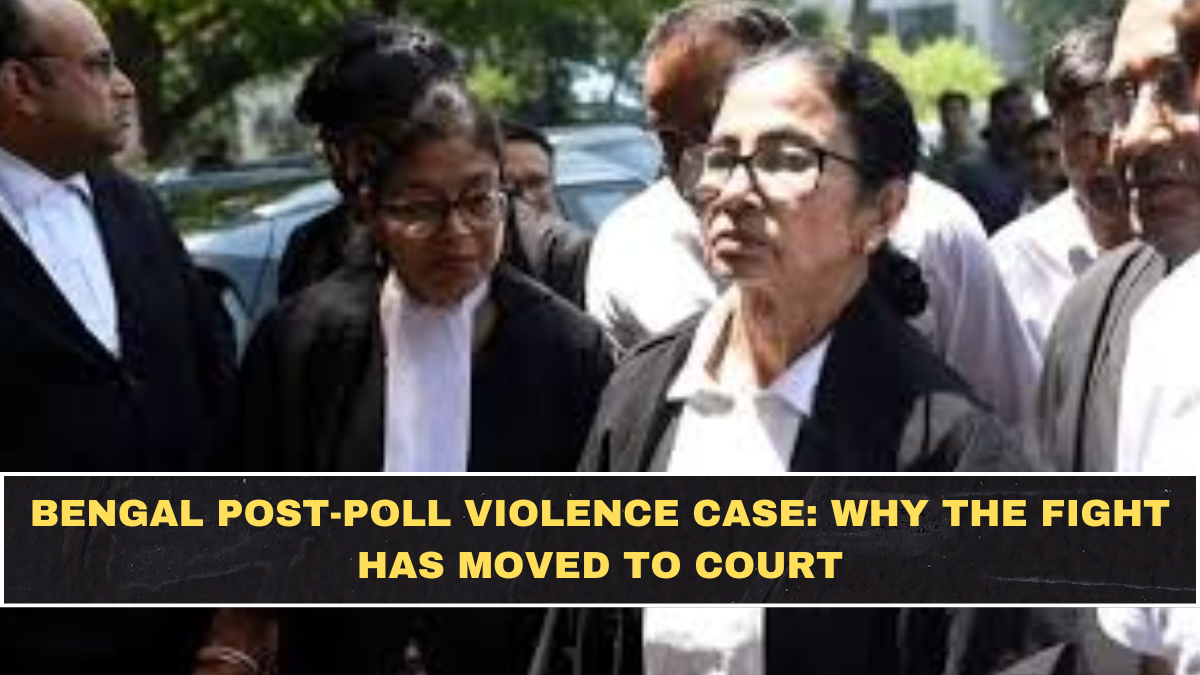
Bengal’s post-poll violence case has again become a national talking point after TMC chief Mamata Banerjee appeared at the Calcutta High Court in connection with a PIL linked to alleged political violence after the 2026 Assembly election results. Reports said she arrived in a lawyer’s gown, turning a legal hearing into a dramatic political moment that immediately drew attention inside and outside Bengal.
This case matters because it is not only about party rivalry. It involves allegations of displaced workers, attacks on party offices, vandalism, police inaction and citizen safety after elections. When political violence reaches the courtroom, it means the normal administrative response is either being questioned or seen as insufficient by those approaching the judiciary.
What Is The Case About?
The case involves allegations of post-poll violence in West Bengal after the Assembly election results. LiveLaw reported that the Trinamool Congress moved the Calcutta High Court alleging widespread post-poll violence, while another PIL before the court sought urgent measures to prevent violence and vandalism in the state.
Reuters earlier reported that hundreds were arrested after post-election violence in West Bengal killed at least three people, including an aide to a senior BJP leader. That shows the matter is not only political noise; it has already involved deaths, arrests and serious law-and-order questions.
| Key Issue | What It Means | Why It Matters |
|---|---|---|
| Post-poll violence | Clashes after election results | Raises law-and-order concerns |
| Court petitions | PILs filed in Calcutta High Court | Judicial scrutiny begins |
| Displaced workers | People allegedly unable to return home | Human safety issue |
| BJP-TMC rivalry | Both sides blame each other | Political heat rises |
| Mamata’s appearance | TMC chief personally appeared in court | Case gained national visibility |
Why Has The Fight Moved To Court?
The fight has moved to court because political violence cases often become trust battles. One side alleges targeted attacks, the other side questions the narrative, and ordinary police action becomes politically controversial. Once people claim they cannot return home safely or FIRs are not being handled properly, the court becomes the place where accountability is demanded.
This is exactly why the Calcutta High Court’s role is important. The court process can force affidavits, status reports, protection measures and clearer responsibility from the state machinery. But the court cannot replace political restraint. If parties keep treating workers as foot soldiers in a revenge cycle, court orders alone will not fix Bengal’s deeper violence problem.
Why Did Mamata’s Appearance Explode?
Mamata Banerjee’s court appearance exploded because of the symbolism. Reports said she appeared in lawyer’s robes, argued the matter and said Bengal is not a “bulldozer state,” while also alleging police inaction in post-poll attacks. That made the hearing both legal and political at the same time.
The controversy did not stop there. Hindustan Times reported sloganeering during her court visit, while the Bar Council of India reportedly sought details about her practice status from the West Bengal Bar Council. This shifted part of the debate from violence allegations to whether her appearance in legal attire was proper.
What Is The BJP-TMC Angle?
The BJP-TMC angle is unavoidable because Bengal politics has become deeply polarised. After a major election result, even local violence quickly becomes a national issue because both parties use it to frame the other side as anti-democratic. BJP is likely to argue that TMC is trying to control the narrative, while TMC is framing its workers as victims needing urgent protection.
The uncomfortable reality is that ordinary workers suffer first in this cycle. Leaders hold press conferences, lawyers argue in court, and television panels shout for hours. But the people at the ground level face intimidation, damaged homes, fear of return and loss of livelihood if the violence is real and unchecked.
What Should The Court Focus On?
The court’s focus should stay on safety, evidence and accountability, not political drama. The priority must be whether people were attacked, whether FIRs were filed, whether displaced families can return safely and whether police acted without bias. If the case turns only into Mamata versus BJP optics, the real victims will disappear from the story.
Important points to watch now:
- Whether the court asks for detailed state response
- Whether displaced people are identified and protected
- Whether FIRs and arrests are independently reviewed
- Whether BJP and TMC submit verifiable evidence
- Whether local administration prevents fresh retaliation
What Is The Bigger Warning?
The bigger warning is that Bengal cannot normalise post-poll violence as part of political culture. Elections are supposed to settle power through votes, not trigger revenge after results. If every election produces fear, displacement and court intervention, democracy becomes weaker at the local level.
The blunt truth is simple: any party defending violence because it helps its side is poisoning the system. Bengal’s political class needs to prove that workers and voters can survive an election result without fear. If it cannot, the court will keep becoming the battlefield after every poll.
Conclusion
The Bengal post-poll violence case has moved to court because the allegations are serious and politically explosive. Mamata Banerjee’s dramatic Calcutta High Court appearance has given the case national visibility, but the real issue is not her robe or the slogans outside court. The real issue is whether citizens and political workers are safe after elections.
If the court process leads to verified facts, safe return of displaced people and accountability for violence, it will matter. If it becomes only another BJP-TMC theatre, Bengal will learn nothing. The state needs justice, not just political performance.
FAQs
What Is The Bengal Post-Poll Violence Case?
The Bengal post-poll violence case involves allegations of political attacks, vandalism, displacement and intimidation after the 2026 Assembly election results. Petitions before the Calcutta High Court have sought judicial intervention and protection measures.
Why Did Mamata Banerjee Appear In Calcutta High Court?
Mamata Banerjee appeared in the Calcutta High Court in connection with a post-poll violence matter. Reports said she arrived in lawyer’s attire and argued for protection of people affected by alleged violence.
Why Is The Case Politically Sensitive?
The case is politically sensitive because it involves the BJP-TMC rivalry after the election results. Both parties are likely to use the case to frame the other side’s role in violence, making the legal issue politically explosive.
What Should Happen Next In The Case?
The court should focus on evidence, protection of displaced people, FIR status, police response and prevention of further violence. The priority should be citizen safety and accountability, not only political messaging.