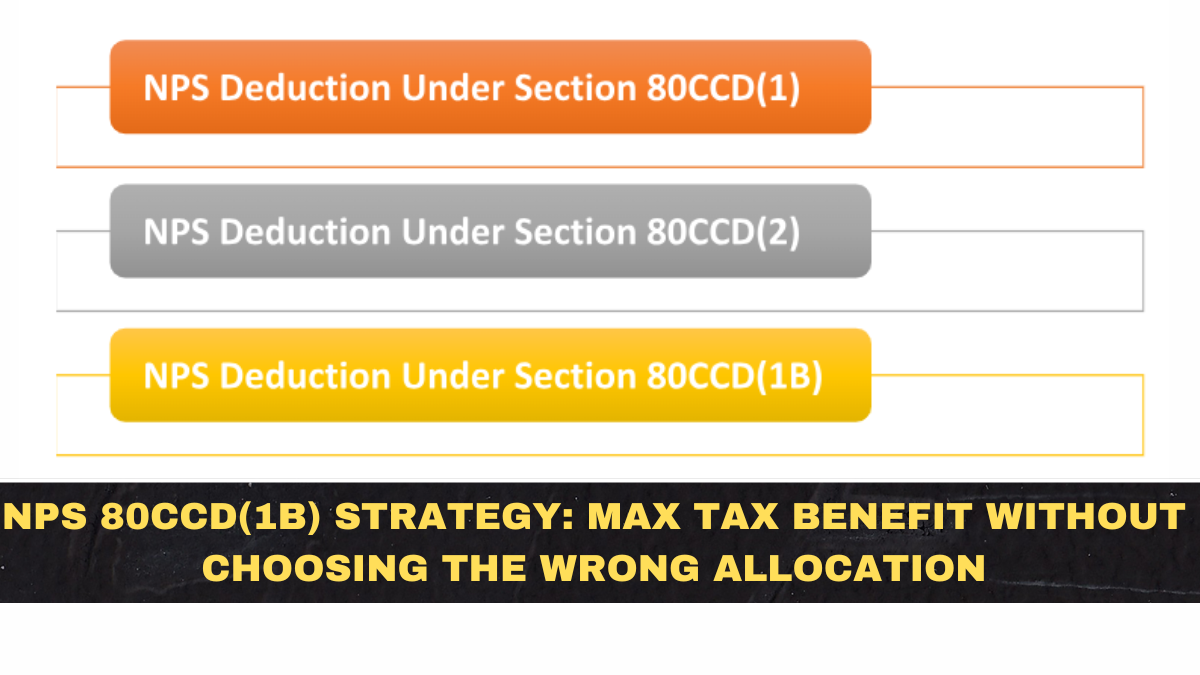
Section 80CCD(1B) allows an additional ₹50,000 tax deduction over and above the ₹1.5 lakh limit under Section 80C. For individuals in the 30% tax slab, this translates into potential tax savings of up to ₹15,600 (₹50,000 × 31.2% including cess).
Despite this clear benefit, many investors either ignore NPS completely or choose incorrect asset allocation within NPS, reducing long-term returns. Tax saving is only half the story. Allocation determines actual wealth creation.
You must optimize both.
How NPS Tax Benefits Work (With Numbers)
NPS offers three layers of tax benefit:
| Section | Maximum Deduction | Applicable To |
|---|---|---|
| 80C | ₹1,50,000 | Employee + Self-employed |
| 80CCD(1B) | ₹50,000 | Additional NPS-only benefit |
| 80CCD(2) | Employer contribution (up to 10% of salary, 14% for govt employees) | Salaried employees |
If you invest ₹50,000 under 80CCD(1B):
| Tax Slab | Approx Tax Saved |
|---|---|
| 5% | ~₹2,600 |
| 20% | ~₹10,400 |
| 30% | ~₹15,600 |
Higher slab means higher effective benefit.
What Many People Get Wrong
Common mistakes include:
-
Investing ₹50,000 purely for deduction without understanding lock-in
-
Choosing overly conservative allocation at young age
-
Ignoring equity exposure limits
-
Not reviewing asset mix annually
NPS locks your funds until retirement (with limited withdrawal rules). Therefore, growth strategy must align with long-term horizon.
Understanding NPS Asset Classes
NPS offers allocation across:
-
Equity (E)
-
Corporate Debt (C)
-
Government Securities (G)
-
Alternative Investment Funds (A, limited exposure)
Maximum equity exposure for private-sector investors is typically capped at 75% (age-dependent under lifecycle option).
Here’s a simplified comparison:
| Asset Class | Risk Level | Expected Long-Term Return Range |
|---|---|---|
| Equity (E) | High | 10–14% |
| Corporate Debt (C) | Moderate | 7–9% |
| Government Bonds (G) | Low–Moderate | 6–8% |
Choosing 75% government bonds at age 30 may protect volatility but limit compounding significantly.
Example Allocation Strategy by Age
| Age | Suggested Equity (E) | Debt (C + G) |
|---|---|---|
| 25–35 | 60–75% | 25–40% |
| 35–45 | 50–60% | 40–50% |
| 45–55 | 30–50% | 50–70% |
| 55+ | 20–30% | 70–80% |
Higher equity early increases retirement corpus potential.
Projected Corpus Example
If you invest ₹50,000 annually for 25 years:
| Expected Return | Estimated Corpus After 25 Years |
|---|---|
| 7% | ~₹31 lakh |
| 9% | ~₹42 lakh |
| 12% | ~₹70 lakh |
The allocation decision significantly changes final outcome. Choosing higher equity exposure early may double corpus compared to conservative allocation.
Tax at Withdrawal Stage
At retirement:
-
60% of corpus can be withdrawn tax-free (current rules).
-
40% must be used to purchase annuity (taxable as income when pension received).
This means NPS is not entirely tax-free at maturity. Planning for annuity income taxation is essential.
When NPS Makes Strong Sense
NPS is particularly beneficial if:
-
You fall in 20% or 30% tax slab
-
You already exhaust 80C limit
-
You want disciplined retirement corpus
-
Employer contributes under 80CCD(2)
The employer contribution benefit is especially powerful because it does not fall within 80C cap.
When NPS May Not Be Ideal
If you are in 5% tax slab or prefer liquidity, NPS may not be optimal. Lock-in until age 60 restricts flexibility.
Investors seeking shorter-term goals should prioritize liquidity-based instruments instead.
Comparing NPS With Other Retirement Options
| Instrument | Lock-in | Risk | Tax Benefit | Liquidity |
|---|---|---|---|---|
| NPS | Till 60 | Moderate–High | Yes (Extra ₹50k) | Low |
| PPF | 15 years | Low | 80C only | Moderate |
| Equity Mutual Funds | None | High | LTCG rules | High |
NPS offers tax advantage but lower liquidity compared to mutual funds.
Conclusion
NPS under 80CCD(1B) provides powerful tax saving of up to ₹15,600 annually for high-slab taxpayers. However, tax saving alone should not drive allocation decisions. Asset mix within NPS determines long-term wealth.
You must choose allocation based on age, risk tolerance, and retirement horizon. Done correctly, NPS becomes both a tax optimization tool and a disciplined retirement builder.
FAQs
Is 80CCD(1B) separate from 80C?
Yes. It provides an additional ₹50,000 deduction beyond the ₹1.5 lakh 80C limit.
What is maximum equity allocation in NPS?
Up to 75% for private sector subscribers, subject to age-based reduction under lifecycle option.
Is NPS fully tax-free at maturity?
No. 60% withdrawal is tax-free, but 40% annuity income is taxable.
Should I choose active or auto allocation?
Active allocation gives control, but lifecycle auto option adjusts risk automatically as you age.