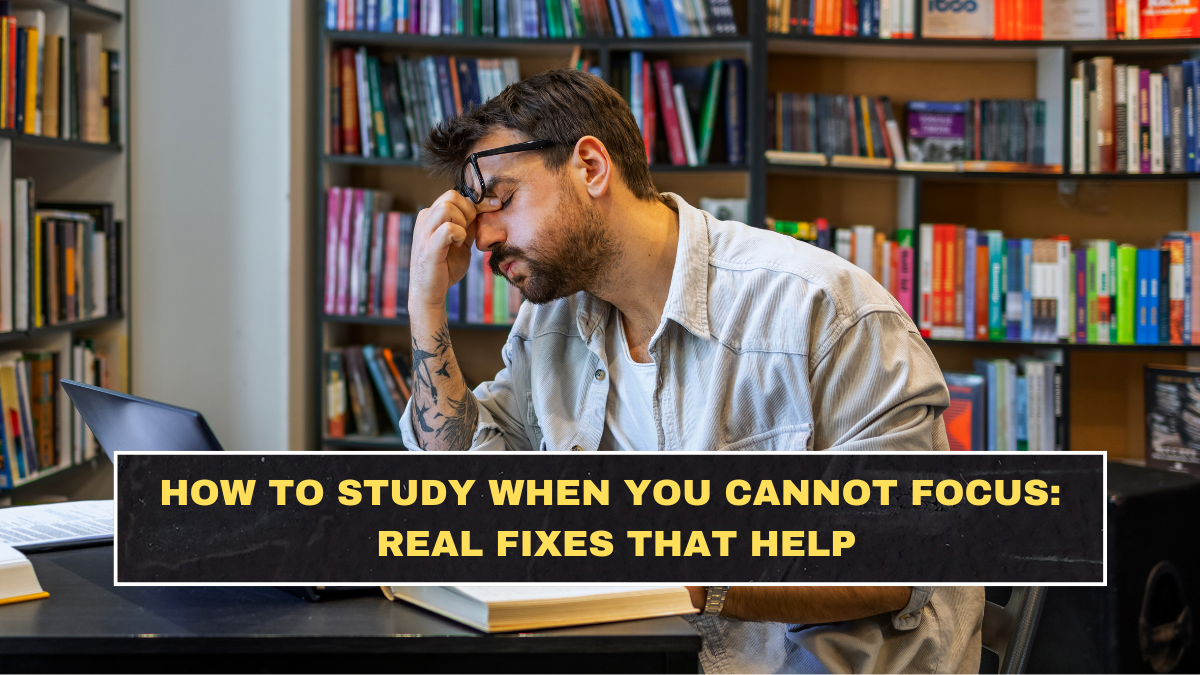
Not being able to focus does not automatically mean you are lazy. It usually means your study system is too heavy, too vague, too distracting, or badly timed for your actual energy. APA guidance for students with inattention says work should be broken into short chunks, and UCLH guidance on brain fog says people should work out when they feel most alert and try to study during those windows instead of forcing focus at the worst time of day.

Why does studying feel impossible when focus is bad?
Because most students try to start with intensity instead of structure. They sit down with a huge chapter, an open phone, vague goals, and zero plan for breaks. That is a bad setup, not a focus strategy. UNC’s study guidance emphasizes active studying and clear direction, while APA recommends shortening work periods to support sustained attention.
What should you do first when you cannot focus?
Shrink the task. Do not tell yourself to “study chemistry.” Tell yourself to finish 10 problems, summarize one page, or make 8 flashcards. APA specifically recommends breaking work sessions into short chunks, and Cornell Health says purposeful breaks improve energy, productivity, and ability to focus. That means the smartest first move is a small target plus a short timer, not a motivational speech.
| Problem | Better fix | Why it works |
|---|---|---|
| Task feels too big | Cut it into 10–25 minute chunks | Lowers resistance to starting |
| Brain feels foggy | Study at your most alert time | Matches work to real energy |
| You keep drifting | Use a timer and one clear goal | Reduces decision fatigue |
| You reread without learning | Switch to questions or flashcards | Forces active recall |
| Breaks become scrolling | Take movement or breathing breaks | Helps reset attention |
Should you use Pomodoro when focus is weak?
Yes, but stop treating 25 minutes like a holy rule. If 25 minutes feels too long, start with 10 or 15. APA supports shorter chunks for people struggling with inattention, and Cornell Health says purposeful breaks can range from 5 to 60 minutes depending on what you need. The point is not the brand name of the method. The point is alternating effort and recovery before your attention collapses.
What study method works better than rereading?
Active recall. Brutal but true: rereading feels productive because it is easy, not because it works well. UNC’s learning guidance recommends retrieval practice and self-testing over passive review, and UCLH also suggests memory-retrieval tools such as cues, key words, diagrams, and to-do lists to support learning when concentration is weak. So instead of reading the same page five times, close the book and try to explain it from memory.
How should your study space change?
Make it harder to get distracted. That means phone away, fewer tabs open, only the materials needed for the next chunk, and less sensory overload. UCLH specifically recommends reducing sensory input, using quiet spaces when needed, and trying noise-cancelling headphones if noise is overwhelming. If your desk is full of random clutter and your phone is face-up beside the notebook, your environment is sabotaging you.
Do breaks actually help, or do they kill momentum?
Good breaks help. Bad breaks wreck momentum. Cornell Health says purposeful breaks refresh the brain and body and improve focus, but also warns that social media does not work well as a purposeful break. Better breaks include walking, stretching, breathing, a short snack, or a brief reset away from the screen. That is why many students feel “more tired” after breaks: they did not take a break, they switched to a different kind of mental clutter.
Does sleep make that much difference?
Yes. CDC says adequate sleep helps students stay focused, improve concentration, and improve academic performance. It also reports that in 2021 a large share of U.S. high school students were not getting enough sleep. If you are trying to outstudy chronic sleep debt with caffeine and guilt, you are solving the wrong problem.
What if your brain feels foggy, slow, or overloaded?
Then slow the process down instead of pretending you can bulldoze through it. UCLH advises students to notice patterns in brain fog, study when more alert, simplify information, switch between formats when useful, and use movement breaks. That means on low-focus days, shorter sessions, simpler goals, diagrams, flashcards, or audio-supported study may work better than dense reading. The smart move is adaptation, not self-criticism.
What is the simplest study routine that actually works?
Use this: pick one tiny goal, study for 10 to 25 minutes, take a real 5-minute break, then test yourself before moving on. After three or four rounds, take a longer break. Add sleep, movement, and better timing around your most alert hours. APA, Cornell Health, UCLH, UNC, and CDC all point in the same direction here: shorter chunks, purposeful breaks, active recall, and better energy management beat forcing yourself to sit there unfocused for three miserable hours.
Conclusion?
If you cannot focus, stop trying to study like a robot. Use shorter chunks, smaller goals, active recall, better breaks, less sensory mess, and more honest timing. Focus usually improves when the system improves. The real mistake is waiting to “feel disciplined” before changing the setup. Discipline helps, but structure helps first.
FAQs
How long should I study if I cannot focus?
Start with 10 to 15 minutes if needed, then build up. APA supports breaking work into short chunks, and Cornell Health supports purposeful breaks during study.
What is the best study method for poor concentration?
Active recall is usually stronger than rereading because it forces you to retrieve information instead of just looking at it again. UNC specifically recommends retrieval-based study.
Do breaks improve focus?
Yes, if they are real breaks. Cornell Health says purposeful breaks can improve energy, productivity, and focus, while social media is a poor break choice.
Can sleep problems make studying harder?
Yes. CDC says adequate sleep supports focus, concentration, and academic performance.