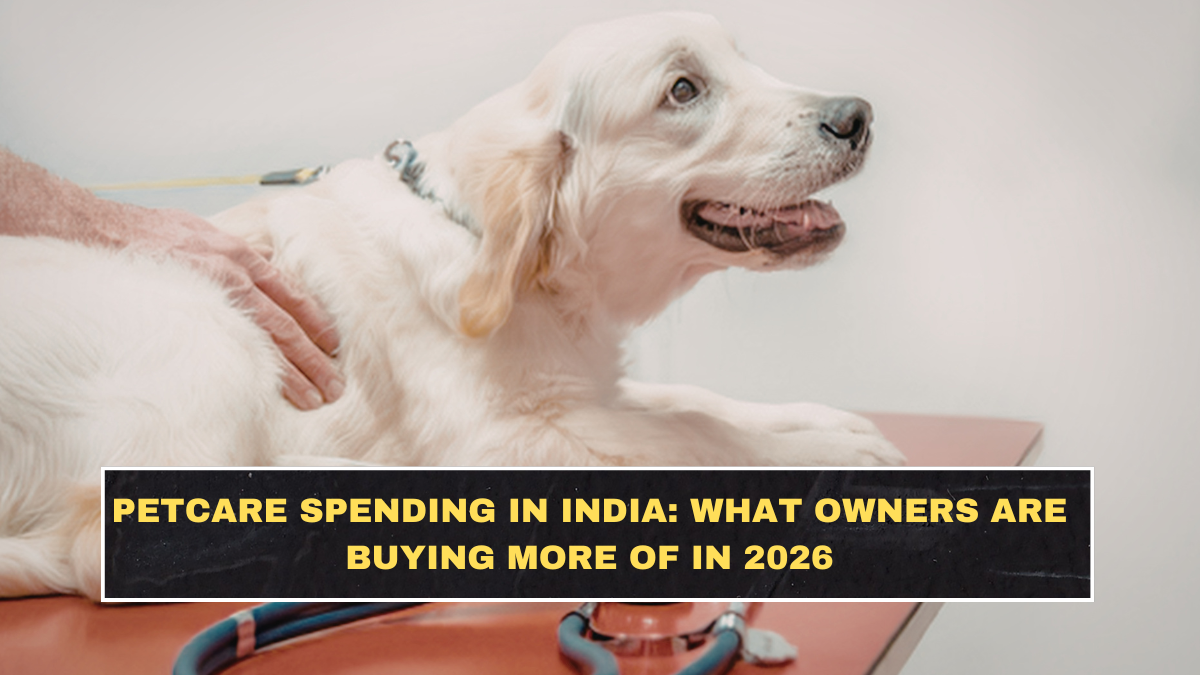
Petcare spending in India is rising because pets are no longer being treated like side animals in many urban households. They are being treated like dependents, and that changes how money gets spent. Redseer reported that Indian pet parents spend roughly ₹50,000 annually on petcare products and services, or about 5% to 8% of household income, which is a serious budget line rather than casual spending. At the market level, IMARC says India’s pet care products market reached about USD 8.6 billion in 2025 and expects continued growth through 2034, while IBEF notes that the pet food segment alone was worth about ₹4,000 crore in calendar year 2024.
That is why this topic matters. This is not just about people buying dog biscuits and shampoo. The spending pattern is getting broader, more premium, and more emotionally driven. India Briefing’s 2025 overview ties the shift to pet humanization, premiumization, and digital commerce, and Reuters reported that Gen Z and younger consumers are increasingly important to spending growth in adjacent pet categories across markets. In India, that translates into more money going toward better food, grooming, healthcare, accessories, and convenience buying.
Why Is Petcare Spending in India Rising?
The growth is happening because pet ownership is rising and the meaning of ownership is changing. IBEF says the industry has been growing at roughly 20% and points to urbanization, e-commerce, and pet humanization as major drivers. India Briefing similarly notes that India may now be home to around 100 million pets, including about 30 million in urban households, which creates a much larger base for repeat spending than older pet-industry assumptions allowed for.
The second reason is emotional upgrading. Owners are not just feeding animals. They are buying “better” food, trying supplements, paying for grooming, booking services, and treating pets more like family members. That is the real engine here. Once a household shifts from survival care to family care, spending expands quickly. This is also why petcare is becoming more organized and brand-driven. Major consumer companies do not enter a category unless they see repeat money in it. Reliance Consumer Products’ entry into petcare with Waggies is one obvious sign that the market now looks commercially serious.
Which Categories Are Getting the Most Spend?
Pet food is still the biggest category by far. IBEF says it accounts for nearly 80% of India’s pet care market, and Euromonitor projections cited there put India’s pet food market on track to reach around ₹10,000 crore by 2028. That alone tells you where the bulk of owner spending still goes. Food wins because it is recurring, easy to premiumize, and easy to segment by life stage, breed size, or health positioning.
But the interesting growth is in what comes after food: grooming, health products, supplements, toys, accessories, and hygiene. Redseer’s pet-parenting analysis breaks spending into both products and services, and the services side matters because it shows owners are not just buying goods. They are paying for maintenance and care experiences too. That is a stronger sign of category maturity than just higher kibble sales.
| Category | Why spending is rising | What it signals |
|---|---|---|
| Pet food | Recurring need, nutrition awareness, premium formulas | Basic care is becoming branded and premium |
| Grooming | Hygiene, appearance, breed-specific care | Pets are being managed like household dependents |
| Health and wellness | Supplements, preventive care, vet attention | Owners are spending before problems get severe |
| Toys and enrichment | Boredom reduction, training, bonding | Humanization and indoor-pet lifestyles |
| Accessories and hygiene | Beds, wipes, litter, clothing, travel products | Convenience and lifestyle spending |
This table shows the core shift clearly: the market is moving from maintenance to lifestyle.
What Are Owners Buying More of in 2026?
The biggest pattern is premiumization. Owners are increasingly buying better-positioned food, health-focused products, and convenience items rather than just the cheapest functional option. IMARC explicitly lists premiumization and rising demand for health-focused, eco-friendly, and organic-style products among the major trends shaping India’s pet care market. TGM Research also noted that Indian consumers show unusually strong interest in eco-friendly pet products compared with global norms, which means spending is not only going up, it is also getting more values-driven and more selective.
The second pattern is channel change. E-commerce and fast digital buying are making premium products easier to discover and repeat-purchase. Navbharat Times reported last week that Gen Z and millennial consumers are helping drive petcare growth and that online platforms such as Flipkart are seeing sharp increases in petcare sales across food, grooming tools, clothes, toys, and health products. That matters because digital shelves tend to push assortment depth and premium choice more aggressively than old neighborhood buying habits did.
Are Indian Pet Owners Spending Smarter or Just Spending More?
Both. Some of the increase is rational. Better food, preventive care, hygiene, and enrichment can genuinely improve a pet’s quality of life. The trouble starts when owners confuse premium pricing with better care automatically. This category is now crowded with emotional marketing, and that means buyers can be manipulated into buying aesthetic nonsense or overpriced wellness products with weak value.
The smarter pattern is easy to spot. Good spending goes toward nutrition, routine healthcare, hygiene, and practical comfort. Weak spending goes toward trend-chasing: too many accessories, low-value novelty items, and premium labels that do not deliver anything meaningful. The market likes both kinds of buyers. Only one kind is thinking clearly.
Why Does This Trend Have Staying Power?
Because it is tied to structural behavior, not just hype. Rising ownership, urban pet parenting, digital commerce, and premiumization are all long-cycle shifts. IMARC, IBEF, and India Briefing all describe a market that is getting more established, more segmented, and more formalized rather than peaking and fading. Once households normalize recurring spend on food, grooming, and care, the base does not disappear just because one social trend cools off.
Conclusion?
Petcare spending in India is rising because pets are being treated less like animals on the edge of the household and more like core family members. Food still dominates spending, but premium food, grooming, wellness, enrichment, and convenience products are all gaining ground. That makes 2026 important: it is the point where the market is no longer just growing in size, it is changing in quality. Owners are spending more, but the smarter ones are also learning where that money actually matters.
FAQs
How much do Indian pet parents spend on petcare?
Redseer says Indian pet parents spend roughly ₹50,000 a year on petcare products and services, or around 5% to 8% of household income.
Which petcare category is biggest in India?
Pet food is the biggest by far. IBEF says it makes up nearly 80% of the overall pet care market.
What kinds of products are growing fastest?
Premium food, grooming, health-focused products, toys, hygiene items, and convenience-driven online purchases are all growing strongly.
Why is petcare spending rising now?
Because pet ownership is increasing, urban households are treating pets more like family, and e-commerce makes premium and specialized products much easier to buy repeatedly.