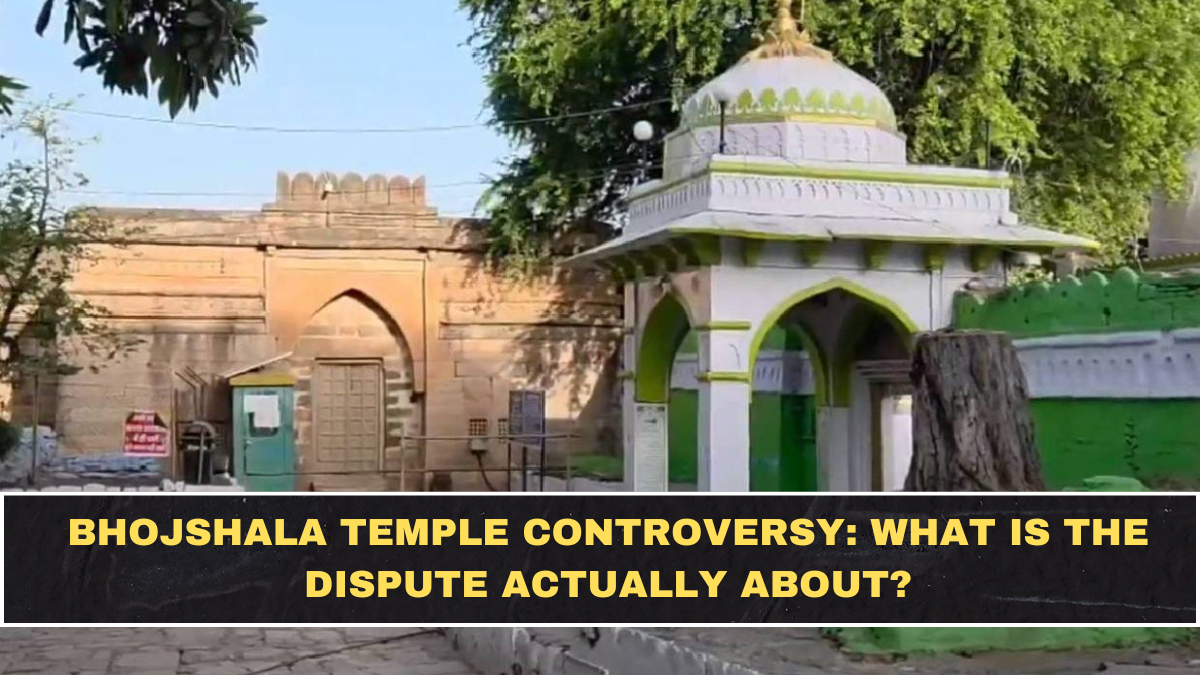
The Bhojshala temple controversy is sensitive because it is not only about one structure in Dhar, Madhya Pradesh. It brings together faith, archaeology, court orders, ASI control, historical claims and community worship rights. The Madhya Pradesh High Court recently ruled that the Bhojshala-Kamal Maula complex is a temple dedicated to Goddess Vagdevi, also associated with Saraswati.
The controversy became sharper because the court also set aside the 2003 ASI arrangement that allowed Hindus to worship on Tuesdays and Muslims to offer Friday prayers at the site. This changed the earlier shared-use structure and made the dispute a national legal and religious flashpoint.
What Is The Core Dispute?
The Hindu side links Bhojshala with Raja Bhoj and Goddess Saraswati, arguing that the complex was historically a temple and centre of Sanskrit learning. The Muslim side has associated the place with the Kamal Maula mosque and the earlier Friday prayer arrangement. That is why the dispute has never been only architectural; it is also about religious identity.
| Issue | Why It Matters |
|---|---|
| Religious identity | Hindu temple claim vs mosque-linked claim |
| ASI control | Site is managed as a protected monument |
| Worship rights | Earlier shared-use system has been quashed |
| Court ruling | High Court recognised temple character |
| Public order | Sensitive issue can trigger tension |
This is exactly why emotional slogans do not explain the controversy properly. One side sees it as historical correction, while the other side may see it as loss of prayer rights at a protected site. The legal question is now tied directly to faith, public access and heritage management.
What Did The Court Change?
The High Court recognised the religious character of the site as a temple dedicated to Goddess Vagdevi or Saraswati. Reports say the court granted daily worship rights to the Hindu side and quashed the earlier ASI order that permitted Muslims to offer namaz at the site on Fridays.
After the verdict, ASI allowed Hindus unrestricted daily access to the Bhojshala complex, and devotees offered prayers at the site. This made the legal decision immediately visible on the ground, rather than remaining only a courtroom development.
Why Is ASI Role Important?
ASI’s role is central because Bhojshala is not just a religiously claimed place; it is also a protected monument. That creates a difficult question: should such a monument be managed mainly as a heritage site, a worship site, or both? This is where the legal and political arguments become complicated.
Critics have already raised concerns. Congress MP Digvijay Singh reportedly argued that an ASI-protected monument cannot simply be treated as a worship place and called the verdict “vague.” His criticism shows that the debate may continue beyond the High Court order.
Why Saraswati Idol Matters?
The Saraswati or Vagdevi connection is one of the most emotional parts of the Bhojshala dispute. NDTV reported that the idol believed to be linked with the shrine is housed in the British Museum in London, and the issue has now gained fresh attention after the verdict.
This matters because heritage disputes often become stronger when they involve objects removed during colonial periods. For supporters of the temple claim, the idol is not just an artefact; it is a symbol of religious and cultural memory. For legal authorities, however, any repatriation effort will require formal diplomatic and institutional process.
What Should Readers Understand?
Readers should avoid reducing the Bhojshala controversy to a simple Hindu-versus-Muslim headline. The dispute involves court interpretation, historical evidence, ASI management, worship practice, protected-monument rules and public order. Anyone pretending this is simple is either uninformed or deliberately oversimplifying.
Key points to remember:
- Bhojshala is located in Dhar, Madhya Pradesh
- The site has competing religious and historical claims
- The High Court recognised it as a temple
- The 2003 shared worship arrangement was quashed
- ASI now has to manage access, conservation and order
- Further legal or political debate is still possible
The blind spot many people miss is heritage conservation. If the site becomes only a political symbol, the monument itself may suffer. Religious access and historical preservation both need careful handling, or the controversy will keep growing.
Conclusion?
The Bhojshala temple controversy is important because it sits at the intersection of faith, law, archaeology and identity politics. The Madhya Pradesh High Court verdict has changed the earlier arrangement by recognising the site as a temple and setting aside the ASI’s 2003 shared-use order.
The blunt truth is that this dispute is not over emotionally, even if one major legal ruling has arrived. The next phase will depend on ASI management, possible legal challenges, political reactions and whether the site can be protected as a heritage monument while handling religious claims responsibly.
FAQs?
What Is Bhojshala Temple Controversy?
The Bhojshala controversy is a dispute over the religious and historical identity of the Bhojshala-Kamal Maula complex in Dhar, Madhya Pradesh. Hindus associate it with Goddess Saraswati, while the Muslim side has linked it with the Kamal Maula mosque.
What Did Madhya Pradesh High Court Say?
The Madhya Pradesh High Court ruled that the site has the religious character of a temple dedicated to Goddess Vagdevi or Saraswati. It also quashed the earlier ASI order that allowed the shared worship arrangement.
Why Was The 2003 ASI Order Important?
The 2003 ASI order had allowed Hindus to worship on Tuesdays and Muslims to offer Friday prayers at the site. The High Court setting it aside is one of the biggest reasons the verdict has become controversial.
Can The Bhojshala Case Go Further?
Yes, further legal challenge or political debate is possible because the issue is sensitive and involves religious rights, protected-monument management and historical claims. Readers should follow official updates rather than social media rumours.