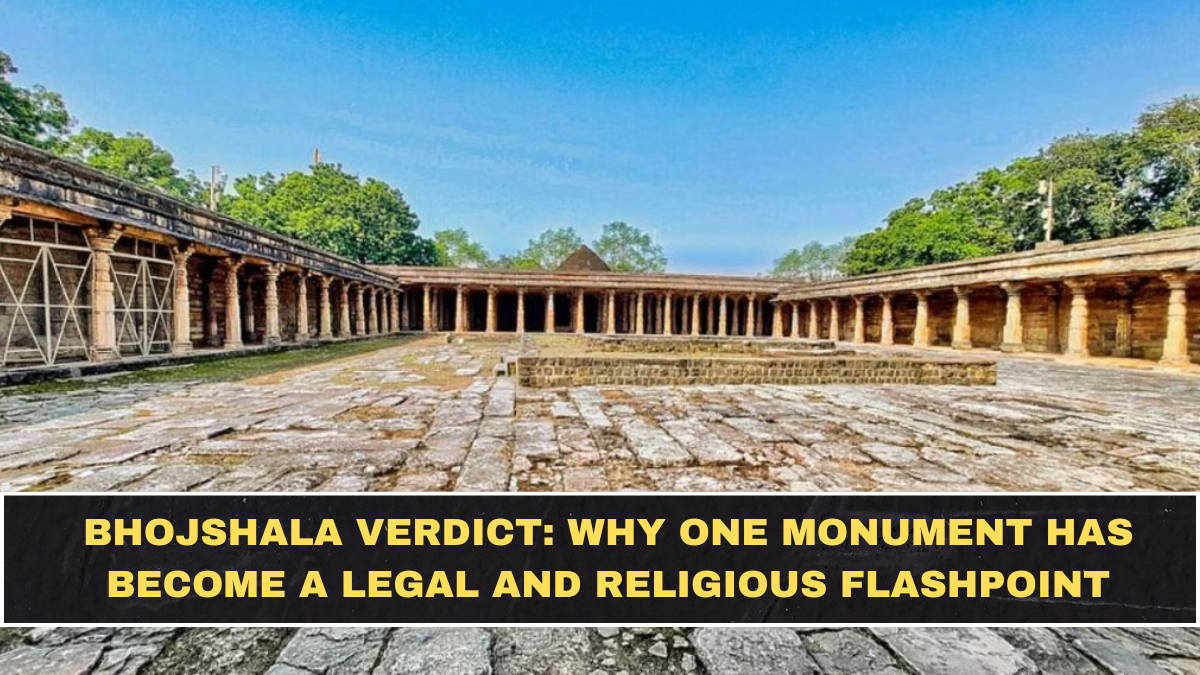
The Madhya Pradesh High Court’s Bhojshala verdict has become a major national talking point because it deals with faith, archaeology, legal rights and heritage control at the same time. The Indore bench ruled that the religious character of the disputed Bhojshala-Kamal Maula complex in Dhar is that of a temple dedicated to Goddess Vagdevi, also associated with Saraswati.
The court also set aside the earlier ASI arrangement that had allowed Muslims to offer Friday prayers at the site, according to multiple reports. This is why the verdict is not just a local Dhar story anymore. It has reopened a sensitive national debate about how protected monuments should be used when two communities claim historical and religious connection to the same place.
What Did The Court Say?
The High Court declared the Bhojshala complex as a temple dedicated to Goddess Saraswati and granted worship rights to the Hindu side. Reports also say the court quashed the 2003 ASI order that had allowed a dual-use arrangement, where Hindus could worship on Tuesdays and Muslims could offer namaz on Fridays.
| Key Point | Verdict Impact |
|---|---|
| Site Identity | Recognised as temple by High Court |
| Earlier ASI Order | 2003 prayer arrangement quashed |
| Hindu Worship | Expanded access after verdict |
| Muslim Prayer | Friday namaz arrangement set aside |
| Site Status | ASI-protected monument remains central |
After the verdict, reports said the ASI allowed Hindus unrestricted daily access to the Bhojshala complex. Devotees also offered prayers at the site after the ruling, making the court decision immediately visible on the ground.
Why Is Bhojshala Disputed?
Bhojshala is located in Dhar, Madhya Pradesh, and is linked by many Hindus with Raja Bhoj and Goddess Saraswati. The Muslim side has historically associated the site with the Kamal Maula Mosque. This dual claim is what made the monument legally and communally sensitive for decades.
The dispute is complicated because the site is not only a worship location for claimants but also a protected monument under the Archaeological Survey of India. That means the issue is not limited to prayer rights. It also involves conservation, historical interpretation, monument management and public order.
Why Are Critics Unhappy?
The verdict has also triggered criticism. Congress MP Digvijay Singh reportedly called the judgment “vague” and argued that an ASI-protected monument should not be treated simply as a place of worship. This criticism shows that the legal and political debate is far from over.
The uncomfortable question is whether courts should decide religious character based on historical and archaeological material when the site has long been administered as a protected monument. Supporters see the verdict as historical correction. Critics see it as a dangerous precedent for other contested heritage sites.
What Happens Next?
The administration and ASI will now have to manage the site carefully because the verdict can attract heavy public attention, political mobilisation and legal challenge. Reports also say the court directed the government to make efforts to bring back the ancient Saraswati idol currently housed in the British Museum in London.
Key things to watch next:
- Whether the verdict is challenged in a higher court
- How ASI manages worship and monument conservation
- Whether local law-and-order arrangements remain tight
- What steps are taken on the Saraswati idol issue
- How political parties frame the verdict nationally
This is not a story that ends with one court order. The ruling may shape future debates around heritage sites where archaeology, faith and modern legal rights collide. That is exactly why Bhojshala has become much bigger than Dhar district.
Conclusion?
The Bhojshala verdict is important because it changes the legal and religious status of a highly sensitive ASI-protected site. The Madhya Pradesh High Court has recognised the complex as a temple dedicated to Goddess Saraswati and quashed the earlier arrangement that allowed Friday prayers at the site.
The blunt truth is that this verdict will not end the debate. It may actually intensify arguments around history, faith, protected monuments and minority rights. For readers, the key is to understand the issue legally and factually, not through emotional slogans or half-baked social media claims.
FAQs?
What is the Bhojshala verdict?
The Bhojshala verdict refers to the Madhya Pradesh High Court ruling that recognised the disputed Bhojshala-Kamal Maula complex in Dhar as a temple dedicated to Goddess Saraswati.
What happened to the 2003 ASI order?
The High Court set aside the 2003 ASI order that had allowed a shared prayer arrangement at the site, including Friday namaz. This is one of the biggest reasons the verdict has become controversial.
Why is Bhojshala important?
Bhojshala is important because it is linked to history, faith, archaeology and ASI monument protection. Hindus associate it with Goddess Saraswati and Raja Bhoj, while the Muslim side has linked it with Kamal Maula Mosque.
Can the Bhojshala verdict be challenged?
The verdict may still face legal challenge through available higher-court remedies. Since the dispute is sensitive and high-profile, future legal developments should be tracked carefully.