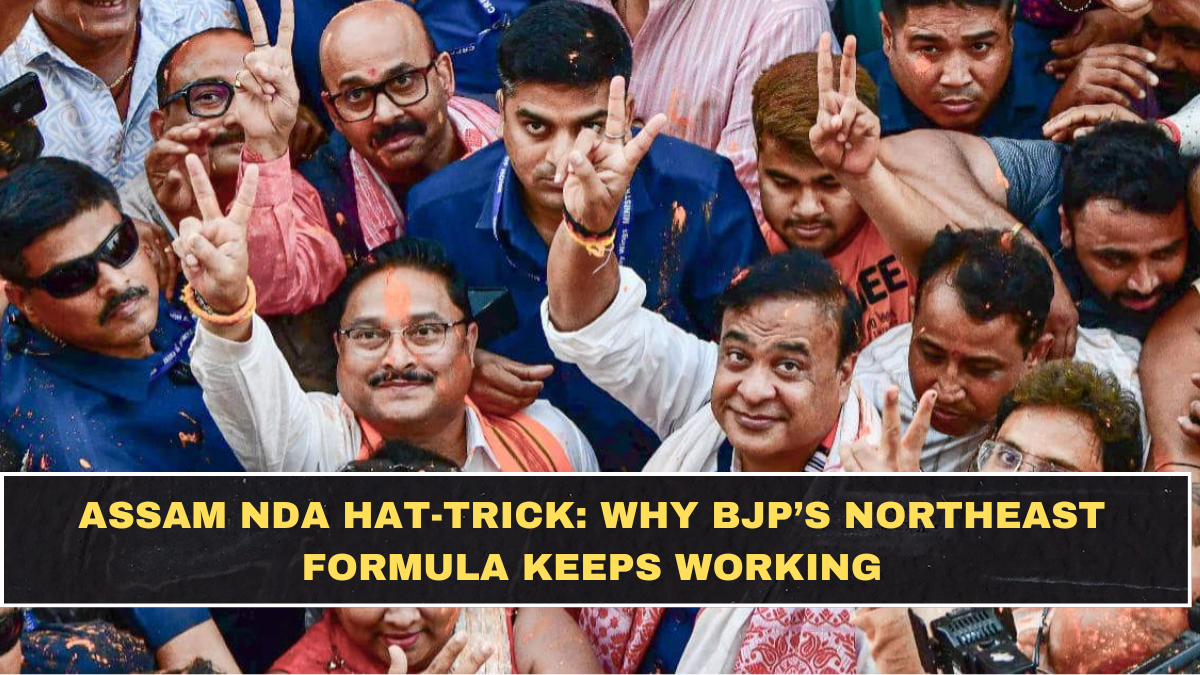
Assam has delivered a clear political message in the 2026 Assembly election: the BJP-led camp is not slowing down in the Northeast. The Election Commission’s Assam results showed BJP winning 82 seats in the 126-member Assembly, while Congress stood at 19 and AGP at 10. That puts BJP comfortably above the 64-seat majority mark on its own, making the victory far more than a narrow alliance-dependent result.
This is why the Assam result is being called a hat-trick moment for the NDA. BJP has managed to turn Assam into one of its strongest eastern anchors, with Himanta Biswa Sarma again at the centre of the campaign story. The result also weakens Congress badly because even after repeated attempts to rebuild in Assam, it has failed to seriously threaten the BJP’s state machinery and ground network.
What Do The Assam Numbers Reveal?
The seat numbers show that BJP’s victory was not just about scraping through. LiveMint reported that BJP registered a hat-trick in Assam and won 82 of the 126 constituencies, while The New Indian Express reported that the NDA crossed the 100-seat mark with allies. This means the BJP’s base and alliance structure worked together to produce a dominant mandate.
| Party/Alliance Point | Result/Position | Why It Matters |
|---|---|---|
| BJP | 82 seats | Clear majority on its own |
| Congress | 19 seats | Failed to mount a serious comeback |
| AGP | 10 seats | Regional ally remains useful |
| Assam Assembly | 126 seats | Majority mark is 64 |
| NDA Trend | Third straight term | BJP’s Northeast formula holds strong |
The table makes one thing obvious: Assam was not a close contest. BJP crossed the majority mark alone, while the broader NDA performance showed that the alliance system still has political value. Congress, meanwhile, remains stuck in a defensive position where it can criticise BJP but cannot yet replace it in the voter’s imagination.
Why Does Himanta’s Model Keep Working?
Himanta Biswa Sarma’s biggest advantage is that he has built a political image around aggressive governance, welfare delivery, identity politics and regional assertion. He does not campaign like a quiet administrator; he campaigns like a leader who wants to dominate the narrative every day. That may irritate opponents, but electorally, it keeps BJP’s voter base energised and opponents on the back foot.
After the result, Sarma said that the state and Centre would work as a “double-engine government” to accelerate development, according to Times of India’s election coverage. That phrase matters because BJP’s Assam strategy is built around connecting state-level leadership with Prime Minister Narendra Modi’s national appeal. For voters who want continuity and central support, that message remains powerful.
Why Did Congress Fail Again?
Congress’s Assam problem is not only leadership; it is credibility. The party has not been able to convince enough voters that it can offer a sharper alternative to BJP’s governance and identity-based strategy. Hindustan Times reported that Jitendra Singh quit as Congress chief after the NDA secured a two-thirds majority, showing how serious the party’s internal damage has become.
Congress also suffered from weak conversion in key seats and a lack of fresh political energy. In contrast, BJP looked organised, confident and locally rooted. The harsh reality is that Congress cannot keep depending on anti-incumbency hope alone. If the ruling party still looks more energetic than the opposition, voters usually choose continuity over experiment.
What Is BJP’s Winning Formula In Assam?
BJP’s Assam success is not accidental. The party has built a layered formula that combines welfare, nationalism, local alliances and strong leadership projection. It also understands that Assam politics is shaped by identity, migration, development and regional pride, not just national slogans.
BJP’s Assam formula includes:
- Strong Chief Minister face in Himanta Biswa Sarma
- Welfare delivery combined with aggressive messaging
- “Double-engine” development pitch with the Centre
- Useful regional allies and local caste-community outreach
- Weak opposition structure and poor Congress revival strategy
This formula keeps working because BJP has made itself look like both the ruling party and the challenger at the same time. It claims governance experience while still attacking rivals aggressively. That is politically effective because it prevents the opposition from owning the change narrative.
Conclusion: Is Assam Now BJP’s Northeast Fortress?
Assam’s 2026 verdict strongly suggests that BJP has turned the state into its most important Northeast fortress. With 82 seats, the party does not need to beg for survival, and with alliance support, it can project an even larger mandate. The result strengthens Himanta Biswa Sarma’s national profile and reinforces BJP’s eastern expansion story.
But BJP should not get arrogant. Assam’s politics can shift quickly if local concerns, unemployment, ethnic tensions or governance fatigue are ignored. For now, though, the verdict is clear: Congress has failed to break through, and BJP’s Northeast formula remains alive, aggressive and electorally profitable.
FAQs
How many seats did BJP win in Assam election 2026?
BJP won 82 seats in the 126-member Assam Assembly, according to the Election Commission’s May 2026 results. Since the majority mark is 64, BJP crossed the halfway point comfortably on its own.
Did NDA win a third term in Assam?
Yes, reports described the result as a BJP/NDA hat-trick in Assam. The New Indian Express reported that the NDA swept Assam for a third straight term, with BJP winning 81 seats and allies pushing the tally past 100.
Why did BJP win Assam again?
BJP won because of Himanta Biswa Sarma’s strong leadership image, welfare delivery, alliance management, identity-based messaging and the “double-engine” development pitch. Congress failed to create a strong enough alternative narrative.
What does this result mean for Congress?
The result is a serious setback for Congress in Assam. With only 19 seats, the party remains far behind BJP and now faces pressure to rebuild leadership, organisation and voter trust before the next major contest.