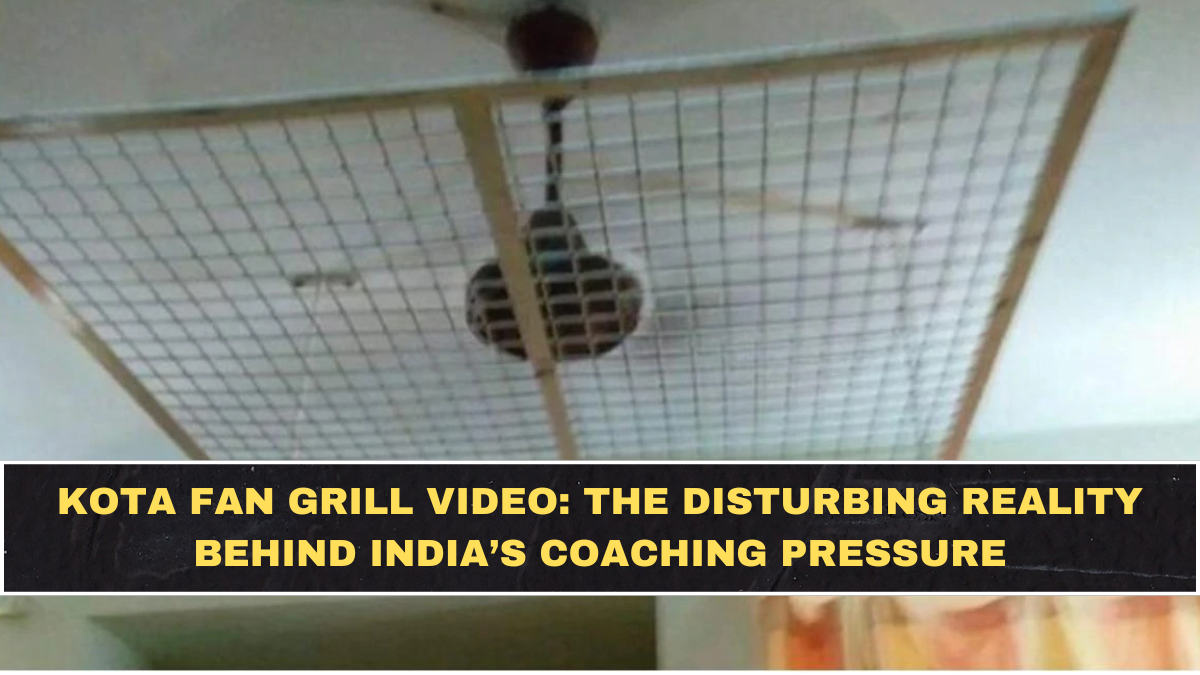
A viral video from Kota hostels has triggered a serious debate after showing ceiling fans covered with heavy iron grills. Times of India reported that the video shows student hostel rooms where fans have been enclosed in iron cages, apparently as a measure to prevent self-harm among students preparing for competitive exams. The clip has disturbed many viewers because it shows how extreme the safety response has become in India’s coaching capital.
The issue is not only about one hostel or one viral reel. Kota has become a symbol of India’s high-pressure coaching culture, especially for NEET and JEE aspirants. When hostel rooms start looking like controlled-risk spaces instead of normal student accommodation, it raises a bigger question: are we solving the mental health crisis, or only trying to block its most visible consequences?
Why Are Fans Being Covered With Iron Grills?
The iron grills appear to be a physical prevention measure linked to student suicide concerns in Kota. This follows earlier administrative steps where authorities ordered hostels to install spring-loaded anti-suicide devices on ceiling fans. Economic Times reported in 2023 that Kota authorities issued directions for hostels to install such devices after 20 student suicides were reported that year at the time of the order.
The idea behind such devices is to reduce immediate access to a common method of self-harm. But let’s not pretend this is a complete solution. Covering fans may reduce one risk point, but it does not remove loneliness, academic pressure, fear of failure, parental burden, coaching stress or untreated depression. A grill can stop access to a fan; it cannot fix a broken support system.
What Does The Data Say About Kota’s Student Suicide Crisis?
Kota’s student suicide numbers show why the issue keeps returning to national attention. Hindustan Times reported that Kota saw 26 suicide cases among coaching students in 2023, 17 in 2024, and 14 cases in 2025 by early May that year. NDTV also reported that 26 suspected coaching-student suicide cases were recorded in 2023, the highest for the city, and that over 2 lakh students come to Kota from across India for medical and engineering entrance preparation.
| Year / Data Point | Reported Figure | Why It Matters |
|---|---|---|
| Coaching-student suicides in 2023 | 26 | Highest reported figure for Kota in available reports |
| Coaching-student suicides in 2024 | 17 | Lower than 2023 but still serious |
| Coaching-student suicides by early May 2025 | 14 | Shows continued concern despite interventions |
| Students reaching Kota for coaching | Over 2 lakh | Explains scale of pressure and accommodation demand |
| Registered hostels/PGs surveyed in 2024 | 4,500 | Shows size of student housing ecosystem |
| Hostels/PGs still lacking spring devices in 2024 survey | Around 300 | Shows compliance gaps in safety measures |
This table makes the problem painfully clear. Kota is not dealing with a one-off tragedy or a random viral moment. It is dealing with a repeated student mental health crisis inside a massive commercial coaching ecosystem. The fan grill video is only the visual symbol of a much deeper failure.
What Did Authorities Already Try Before This Viral Video?
Kota authorities have already tried several safety-focused measures over the years. NDTV reported in February 2025 that the district administration released guidelines for coaching centres and hostels under the Kota Cares Campaign ahead of the 2025–26 academic session. The guidelines included measures such as anti-suicide ceiling fans and hostel-level monitoring responsibilities.
Hindustan Times also reported in May 2024 that a district survey found around 300 hostels and PG accommodations had still not installed mandated spring-loaded ceiling fan devices. The same survey found that staff at several accommodations had not completed mandatory training to identify stress and depression signs among students. That is the uncomfortable part: rules exist, but implementation gaps still remain.
Why Is This Not Just A Hostel Safety Issue?
This is not just a hostel safety issue because the source of the crisis begins before a student reaches the hostel room. Many students arrive in Kota after Class 10 or Class 11, away from family, under huge financial and emotional pressure. Their day is often built around coaching classes, tests, rankings, comparison, doubt, exhaustion and fear of disappointing parents.
A student does not become mentally unsafe only because a fan exists in the room. That is the shallow reading. The deeper problem is that many students are pushed into a system where performance becomes identity. If marks fall, they feel like they have failed not just an exam, but their family, future and self-worth. That is where the real danger begins.
What Should Coaching Institutes And Parents Learn From This?
Coaching institutes need to stop treating mental health as a PR checkbox. Having one counsellor, one poster or one helpline number is not enough when students are living under constant test pressure. Institutes should track attendance changes, sudden score drops, isolation, repeated panic, sleep problems and emotional withdrawal with the same seriousness as test performance.
Parents also need to face a brutal truth. Many students are not only afraid of exams; they are afraid of going home as “failures.” If parents constantly attach love, respect and family pride to rank or selection, they become part of the pressure machine. A child preparing for NEET or JEE needs support, not emotional debt disguised as motivation.
What Help Is Available For Students In Distress?
Students in distress should speak to someone immediately: a trusted friend, parent, hostel warden, teacher, counsellor or doctor. The Government of India’s Tele-MANAS service provides free 24/7 mental health support. The official Tele-MANAS website says people can call 14416 to connect with a counsellor, and PIB has also listed 14416 and 1-800-891-4416 as toll-free numbers with multi-language support.
This point needs to be said directly: asking for help is not weakness. Staying silent while breaking inside is not strength. If a student feels trapped, unsafe, hopeless or unable to cope, that is not a “discipline problem.” It is a serious signal that they need immediate human support and professional help.
What Is The Conclusion?
The Kota fan grill video is disturbing because it shows how far the student safety crisis has gone. Iron grills around hostel fans may reduce one form of immediate risk, but they also expose a painful reality: the system is reacting to symptoms after students have already reached a dangerous point. That is not enough.
The data shows repeated student suicide concerns in Kota, large-scale hostel dependence, and gaps in safety compliance. The real solution cannot be only cages, grills or spring devices. Kota needs stronger counselling, better hostel monitoring, humane coaching practices, parent education and early mental health intervention. Anything less is just decoration over a crisis.
FAQs
Why Are Ceiling Fans Covered With Iron Grills In Kota Hostels?
Ceiling fans are reportedly being covered with iron grills as a safety measure to prevent self-harm among students. The viral video has sparked concern because it reflects the extreme pressure and mental health risks faced by coaching students in Kota.
How Many Student Suicide Cases Were Reported In Kota?
Reports state that Kota recorded 26 coaching-student suicide cases in 2023 and 17 in 2024. Hindustan Times also reported that 14 cases had already been reported in 2025 by early May that year, showing that the crisis continued despite interventions.
What Is Tele-MANAS And How Can Students Use It?
Tele-MANAS is a Government of India mental health support service that offers free 24/7 counselling. Students or anyone in distress can call 14416 to speak with a counsellor, and PIB has also listed 1-800-891-4416 as another toll-free helpline number.