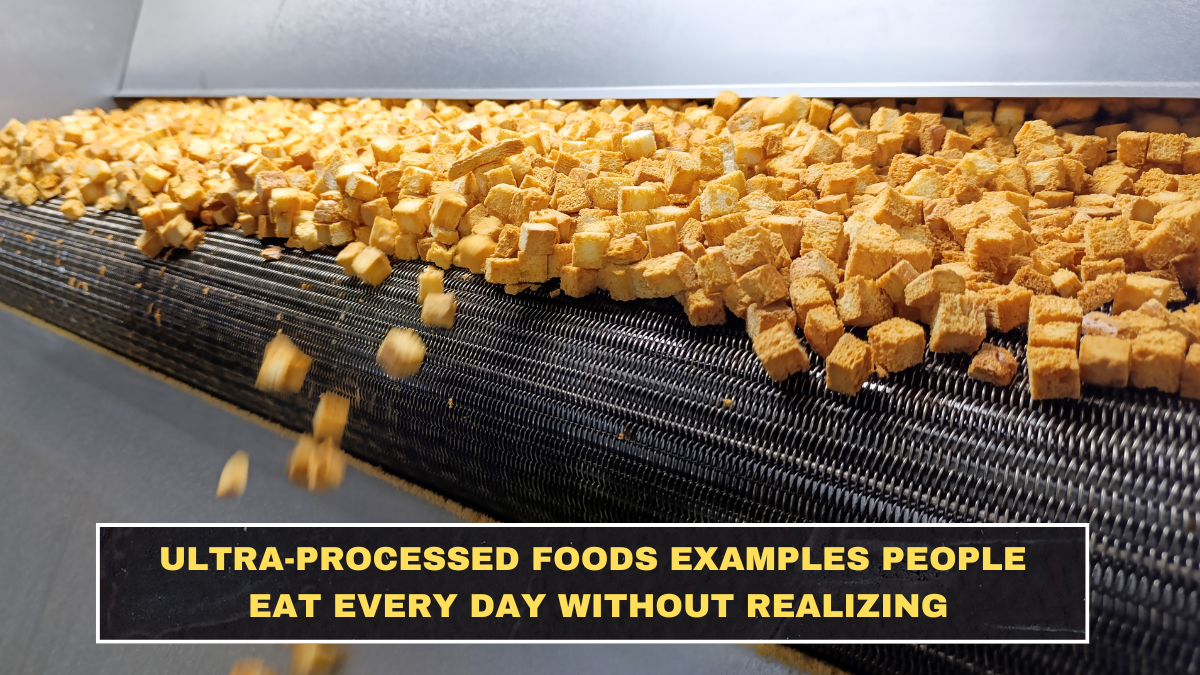
This is where people get confused fast. “Processed” and “ultra-processed” are not the same thing. Harvard’s Nutrition Source explains that not all processed foods are a problem by default, because freezing vegetables, canning beans, or making plain yogurt still counts as processing. Ultra-processed foods are the more industrial products made with ingredients and additives you would not usually use in a home kitchen, often designed to be convenient, hyper-palatable, and heavily packaged.
That means the issue is not whether a food came in a package. The issue is what the product actually is. A bag of frozen broccoli is processed. A neon-colored cheese snack with a long ingredient list is a different category entirely. Mayo Clinic Health System says the most heavily or ultra-processed foods include sweetened breakfast cereals, soda, energy drinks, flavored crackers, potato chips, chicken nuggets, and hot dogs.
Which ultra-processed foods do people eat all the time without thinking about it?
The obvious examples are soda, candy, chips, packaged cakes, and instant noodles. But the everyday list is broader than people think. Harvard Health and Johns Hopkins both point to items such as chips, cookies, crackers, boxed macaroni and cheese, frozen or ready-to-eat meals, lunch meats, hot dogs, sugary cereals, and other prepackaged snack foods as common ultra-processed foods.
That is why people often underestimate how much of this category they eat. They picture only junk food, while ignoring the sweeter breakfast cereal, the packaged snack bar, the deli meat sandwich, the frozen dinner, and the flavored crackers in the pantry. The food may feel normal because it is common, but common and minimally processed are not the same thing.
| Common food | Why it often counts as ultra-processed |
|---|---|
| Sugary breakfast cereals | Industrial formulation, additives, added sugar |
| Soda and energy drinks | Highly formulated, little nutritional value |
| Chips and flavored crackers | Refined ingredients, additives, flavor systems |
| Chicken nuggets and hot dogs | Reconstituted ingredients and industrial processing |
| Boxed mac and cheese | Refined starches, additives, convenience formulation |
| Frozen ready meals | Multi-ingredient industrial products designed for reheating |
What label clues should shoppers actually look for?
A long ingredient list alone does not prove something is ultra-processed, but it is often a clue. Harvard’s food-label guide says the ingredient list helps reveal how much a food has been altered and what has been added. Ingredients such as emulsifiers, artificial flavors, colors, sweeteners, hydrogenated oils, and multiple refined starches or isolates are the kinds of things that tend to push a product deeper into the ultra-processed category.
That said, people still oversimplify this. “Hard to pronounce” is not a scientific test. Some foods with added ingredients can still be reasonable choices, and some foods not labeled ultra-processed can still be high in salt, sugar, or saturated fat. The label should help you think more clearly, not turn you into someone panicking over every ingredient they do not recognize.
Why does this topic get oversimplified so badly?
Because people love clean villains. It feels easier to sort food into “real food” and “bad food” than to admit the topic is messier. Harvard’s processed-food guidance makes clear that processing exists on a spectrum, and the National Academy of Medicine warned in late 2025 against an all-or-nothing approach, saying ultra-processed foods cannot be universally labeled healthy or unhealthy in every case.
That matters because a packaged whole-wheat bread, an instant oatmeal packet, and a frozen veggie burger do not land in the same practical category as soda and frosted snack cakes, even if people online try to flatten the whole conversation. The smarter question is not “Is this food ultra-processed, yes or no?” It is “How much of my diet is coming from heavily engineered convenience food, and what is that displacing?”
Are ultra-processed foods actually linked with worse health?
Broadly, yes, though people should stop pretending that means one packaged food ruins a diet. A 2024 BMJ study found that higher intake of ultra-processed foods was associated with slightly higher all-cause mortality, and a BMJ Group summary of a 2024 umbrella review said consistent evidence linked ultra-processed food intake with more than 30 adverse health outcomes. These studies support concern, but they do not justify hysterical, guilt-heavy food talk.
The real issue is pattern, not purity. If a diet is dominated by sugary drinks, snack foods, fast convenience meals, and low-fiber packaged items, that is a different situation from eating mostly whole foods while also using some packaged bread, yogurt, or cereal in practical ways. Pretending those are identical is lazy thinking.
How should normal people use this information?
Use it to get less fooled, not more paranoid. Learn the common examples. Read labels more carefully. Notice how often meals are built from highly engineered snack products instead of actual food. But do not turn grocery shopping into a moral panic. The point is not perfection. The point is making a bigger share of your diet come from foods that still look like food. That is a lot more realistic than acting like you are going to live on farm-fresh produce and homemade broth forever.
FAQs
What is the easiest way to recognize an ultra-processed food?
Common clues include highly formulated packaged products, long ingredient lists with additives, and foods designed mainly for convenience and hyper-palatability, such as soda, chips, sweet cereals, and ready meals.
Are all processed foods unhealthy?
No. Harvard makes clear that processing exists on a spectrum, and foods like frozen vegetables or canned beans are processed without automatically being ultra-processed.
Is packaged bread always ultra-processed?
Not always. Some packaged breads are more heavily processed than others, which is one reason this topic gets oversimplified. Context and ingredients matter.
What are common ultra-processed foods people miss?
Sweet breakfast cereals, flavored crackers, deli meats, boxed mac and cheese, frozen meals, chips, soda, and energy drinks are common examples people eat routinely without thinking much about them.