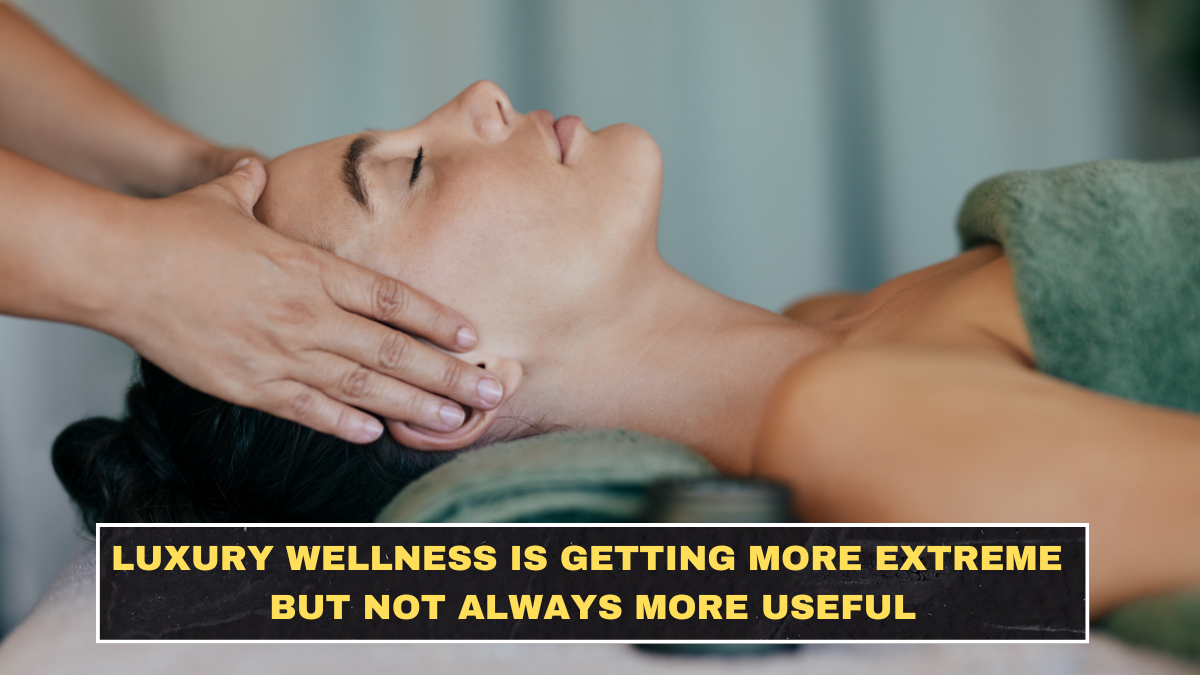
Luxury wellness is growing because health has become a status product, not just a medical concern. The Global Wellness Summit’s 2026 trends report says the market has been reshaped by high-tech, medical, hyper-optimizing approaches, including the boom in longevity clinics, diagnostics, wearables, and biotech-driven wellness. At the same time, premium travel and hospitality brands are building more wellness-focused experiences because affluent travelers are actively paying for them. Simon-Kucher’s global travel trends report said 58% of high-income travelers were planning a wellness-related holiday, versus 26% of lower-income travelers.
That demand is not really about health alone. A growing share of the market is selling identity, control, and elite access. Luxury wellness now includes longevity clinics, executive biomarker testing, sleep optimization suites, IV drips, red-light therapy, cold exposure rituals, continuous tracking, and full-body scans. The trend is real, but the uncomfortable truth is that the price tag often rises faster than the evidence. MIT Technology Review’s survey of 82 longevity clinics, reflected in linked summaries, found a messy landscape with wide variation in standards, training, and treatment quality, while a 2025 commentary in Aging warned that clinics often adopt unproven or risky therapies and sell exotic supplements or IV cocktails with minimal evidence.
Longevity clinics are growing because people want control over ageing
The pitch is simple and emotionally powerful: do not wait to get sick, start optimizing now. That is why longevity clinics are attractive to wealthy clients. A 2024 framework paper on healthy longevity clinics says these clinics aim to improve healthspan through personalized prevention, diagnostics, and targeted interventions, which sounds rational on paper. The problem is that the same category now includes everything from sensible screening and coaching to speculative anti-ageing treatments sold far ahead of strong evidence.
This is where buyers fool themselves. They assume expensive means advanced and advanced means proven. That logic is weak. Some parts of premium preventive care are sensible: sleep assessment, metabolic risk tracking, blood pressure control, exercise planning, and medical supervision for genuine risk factors. But once the clinic starts packaging every uncertainty as something to “optimize,” the customer can slide from prevention into overmedicalized lifestyle theater. The Washington Post reported in January 2026 that longevity medicine has moved into the mainstream, but the enthusiasm has outpaced rigorous evidence and regulatory standards.
What is useful and what is mostly marketing
The easiest way to cut through the hype is to separate foundational health from luxury add-ons. Foundational health is still boring: sleep, exercise, nutrition, blood pressure, metabolic health, smoking avoidance, and mental health. Luxury add-ons become questionable when they promise broad anti-ageing or optimization benefits without strong outcome data. Whole-body MRI is a good example. A peer-reviewed review in the NIH archive concluded that providers should not offer whole-body MRI for preventive screening to asymptomatic people outside research settings because incidental findings can lead to unnecessary follow-up, anxiety, and cost.
That does not mean every premium service is useless. It means the burden of proof matters. If a service can identify a clear risk, guide a real treatment decision, or improve adherence to proven habits, it may have value. If it mainly creates a feeling of control, exclusivity, or optimization without strong evidence of better outcomes, then it is probably expensive reassurance dressed up as science. That is the core blind spot in luxury wellness: people confuse feeling proactive with actually reducing risk.
Where luxury wellness is getting most extreme
| Trend area | What is happening | What to watch out for |
|---|---|---|
| Longevity clinics | Personalized diagnostics and anti-ageing programs are expanding | Evidence and standards vary widely. |
| Biohacking travel | Resorts and luxury hotels are adding recovery, cold, heat, and optimization rituals | Can drift into premium performance theater. |
| Sleep luxury | Hotels now sell sleep suites, circadian lighting, and premium recovery experiences | Better sleep is useful; ultra-premium packaging is often the markup. |
| Full-body scans and diagnostics | Preventive scans are being marketed to healthy people | Incidental findings can create anxiety and extra costs. |
| Wearables and tracking | More data is being used to sell personalization | More data does not automatically mean better health decisions. |
Why the trend appeals to wealthy buyers
Affluent buyers are not just purchasing treatment. They are purchasing immediacy, privacy, personalization, and the feeling that they are ahead of decline. That is why the luxury layer matters so much. It turns ordinary health goals into premium rituals. The New York Post described this as the “Erewhon-ification” of medicine, where health itself becomes a status symbol expressed through home IV therapy, red-light devices, peptide injections, and subscription-based diagnostics. That framing is blunt, but accurate enough: luxury wellness often sells a social signal alongside a service.
The problem is that this can encourage overtesting and overintervention. A person who would benefit most from regular exercise, sleep, and better diet may instead spend heavily on biomarkers, peptides, or boutique therapies because they feel more advanced. That is upside-down decision-making. The basics remain more useful than most luxury add-ons, but the basics do not look exclusive enough for the market being targeted.
What premium preventive care can still do well
There is a serious version of this market that should not be dismissed. Better access to high-quality diagnostics, physician time, personalized coaching, and easier follow-up can help people who would otherwise ignore their health. Premium care can also improve adherence because convenience makes action more likely. The value is strongest when it helps clients execute proven behavior change or identify genuine clinical risk early.
But that serious version is narrower than the marketing suggests. Luxury wellness is most defensible when it improves delivery of evidence-based care. It is least defensible when it packages speculative interventions as if they are medically established. The difference matters. Without that distinction, buyers can spend thousands to optimize numbers that may not meaningfully improve how long or how well they live.
Conclusion
Luxury wellness is getting more extreme in 2026 because affluent consumers are buying not just health support, but identity, control, and exclusivity. Longevity clinics, biohacking retreats, and premium diagnostics are expanding because the demand is real. But a big share of the category is still ahead of the evidence. The smartest way to look at this market is brutally simple: useful if it improves proven care, wasteful if it mainly sells expensive certainty and status.
FAQ
What is luxury wellness?
Luxury wellness refers to premium health and wellbeing services sold through elite clinics, resorts, hotels, and memberships. It often includes diagnostics, sleep programs, recovery tech, biohacking services, and longevity-focused care.
Are longevity clinics evidence-based?
Some parts are grounded in preventive medicine, but standards vary and many clinics offer interventions with limited evidence. Surveys and expert commentaries have warned that the field is inconsistent and sometimes overpromises.
Are full-body MRIs a smart preventive purchase?
Not routinely for healthy people. A peer-reviewed review concluded whole-body MRI should not be offered to asymptomatic people outside research settings because incidental findings can trigger unnecessary anxiety, testing, and expense.
Is biohacking the same as preventive healthcare?
No. Preventive healthcare focuses on reducing proven risks through evidence-based action. Biohacking often mixes some useful practices with trend-driven or weakly supported interventions. That is why the category needs skepticism, not blind enthusiasm.