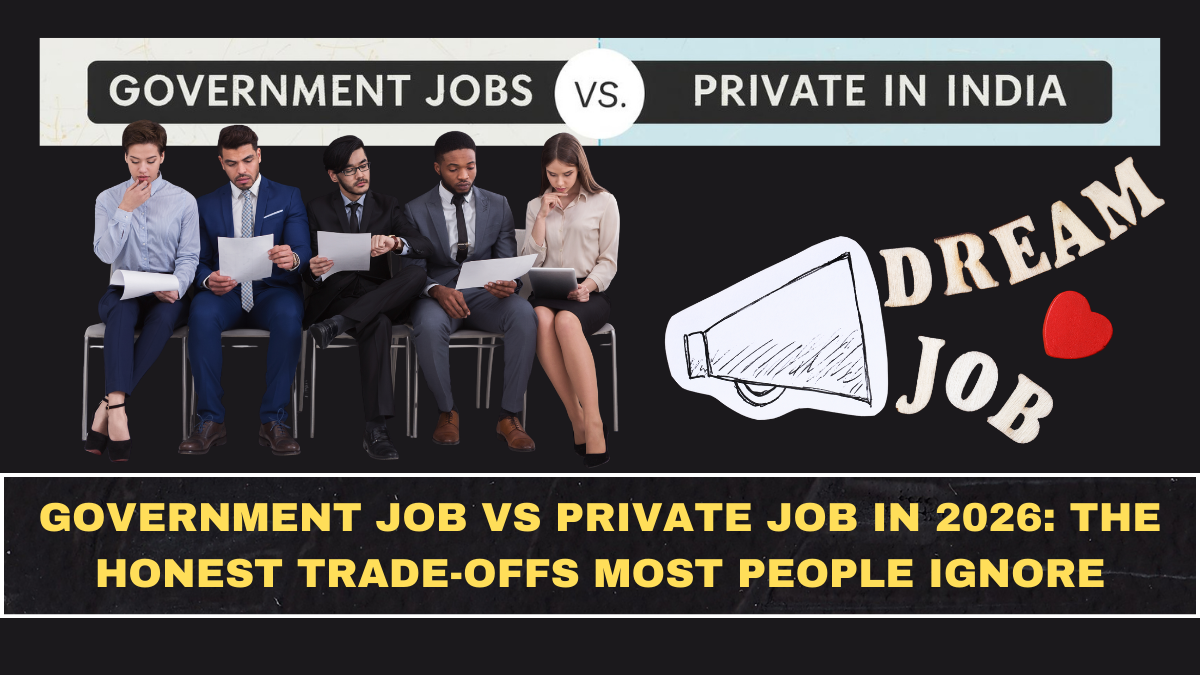
Choosing between a government job and a private job in India has always been framed as a simple choice between “security” and “money.” In 2026, that framing is incomplete and often misleading. Both paths have evolved, pressures have shifted, and many assumptions people still rely on no longer match reality.
Most wrong career decisions happen because people compare only starting salary or social status. They ignore growth patterns, stress structure, transfer realities, and long-term lifestyle costs. This article breaks down the real trade-offs between government and private jobs in India in 2026 so you can choose with clarity instead of inherited beliefs.
Why This Comparison Is More Confusing in 2026
The private sector is no longer uniformly unstable, and government jobs are no longer uniformly relaxed. Performance metrics, digital monitoring, and accountability have entered both spaces.
At the same time, layoffs, contract roles, and restructuring have made many families risk-averse. This pushes people toward government jobs without understanding the daily realities involved.
In 2026, the confusion comes from outdated narratives applied to a changed market.
Income Growth: Fixed Progression vs Variable Upside
Government jobs offer predictable income growth through pay commissions and promotions. Increments are steady but slow, and large jumps are rare.
Private jobs offer uneven growth. Some experience rapid salary jumps, while others stagnate or face pay cuts during downturns. Growth depends on role, sector, and individual leverage.
In 2026, government income is predictable; private income is probabilistic.
Job Security: Perceived vs Practical Stability
Government jobs still provide stronger protection against sudden termination. This reduces anxiety, especially for those with family responsibilities.
Private jobs can be secure in stable sectors, but restructuring risk always exists. Security depends more on skills than designation.
In 2026, government jobs reduce downside risk, not all risk.
Workload and Stress Reality
Government roles vary widely. Some departments are relaxed, others are understaffed and overloaded. Stress often comes from administrative pressure rather than performance targets.
Private jobs usually have clearer KPIs and faster feedback. Stress is performance-linked and visible, but control over output is higher.
In 2026, stress exists in both paths, just in different forms.
Work-Life Balance and Time Control
Government jobs generally offer more predictable schedules and leaves, though exceptions exist in field roles.
Private jobs can offer flexibility, remote work, and faster exits, but also longer hours during peak cycles.
In 2026, work-life balance depends more on role design than sector label.
Transfers, Location, and Personal Control
Government jobs often involve transfers, sometimes without choice. This affects family stability, children’s education, and spouse careers.
Private jobs offer more location control, but job changes may force relocation anyway.
In 2026, government roles reduce job-switch anxiety but increase location uncertainty.
Skill Growth and Market Value
Private jobs usually demand continuous upskilling to stay relevant. Skills gained often remain transferable across companies.
Government roles may limit exposure to modern tools in some departments, reducing external market value.
In 2026, private careers compound skills faster, government careers compound tenure.
Promotion and Recognition Systems
Government promotions are time-bound and hierarchical. Performance impact is often limited by structure.
Private promotions can be faster but less predictable. Visibility, results, and negotiation play a big role.
In 2026, government rewards patience; private rewards positioning.
Financial Planning and Lifestyle Impact
Government income supports long-term planning through stability and pensions or retirement benefits.
Private income supports faster wealth creation when managed well, but requires stronger financial discipline.
In 2026, lifestyle fit matters more than headline salary.
Who Should Choose a Government Job
Those who value predictability, low financial anxiety, and long-term stability usually thrive in government roles.
People uncomfortable with uncertainty or frequent career negotiation find peace here.
In 2026, government jobs suit risk-averse planners.
Who Should Choose a Private Job
Those who enjoy skill-building, autonomy, and income acceleration often prefer private roles.
People willing to handle volatility for growth adapt better here.
In 2026, private jobs suit adaptable performers.
Conclusion: There Is No “Better” Choice, Only Better Fit
Government job versus private job is not a moral or status decision. It is a lifestyle and risk decision.
The wrong choice creates long-term dissatisfaction, even if it looks good socially. The right choice aligns income, stress tolerance, family needs, and growth expectations.
In 2026, clarity beats comparison, and fit beats prestige.
FAQs
Are government jobs still safer than private jobs in 2026?
Yes, in terms of termination risk, but workload and pressure vary by role.
Do private jobs always pay more?
Not always. Long-term earnings depend on skill growth and career movement.
Is work-life balance better in government jobs?
Often yes, but not guaranteed in all departments.
Can I switch from private to government later?
Yes, but age limits and eligibility rules apply.
Which option is better for financial stability?
Government jobs offer stability; private jobs offer higher upside with risk.
Should family pressure decide this choice?
No. Family input matters, but the final decision must match your temperament and goals.