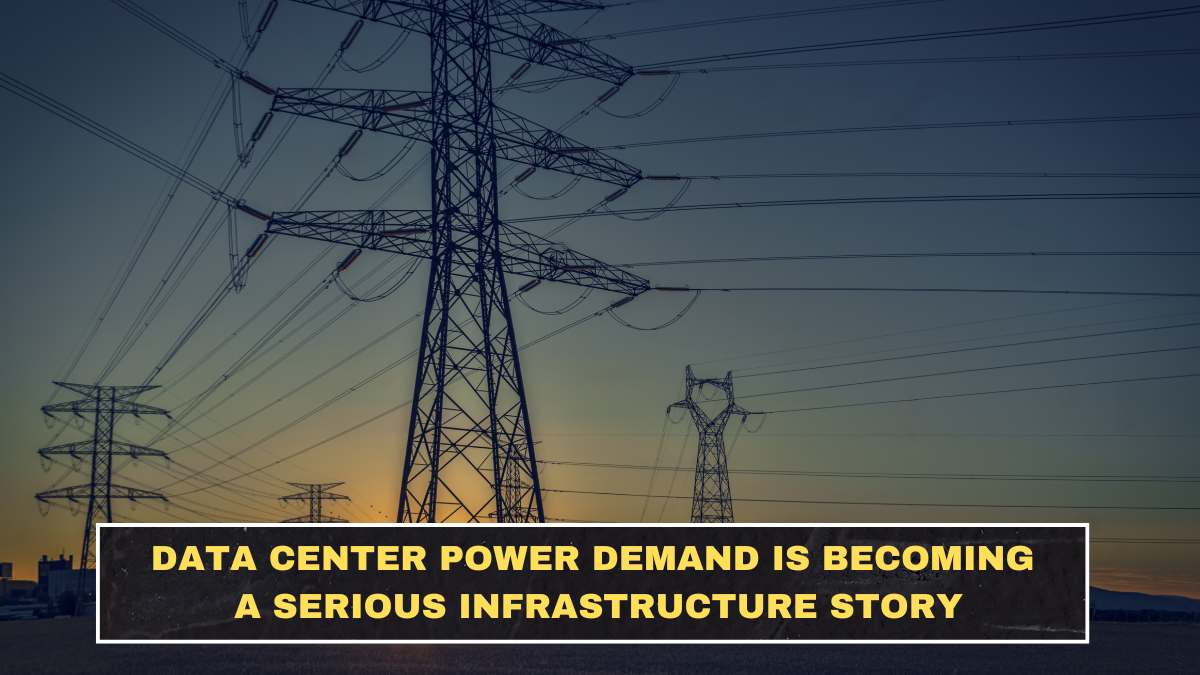
Data center power demand is no longer a niche tech issue. It is becoming a real infrastructure story because AI workloads need large amounts of electricity, fast grid connections, and reliable power around the clock. The International Energy Agency says global electricity consumption by data centers is projected to more than double from about 415 TWh in 2024 to around 945 TWh by 2030, with AI as the main driver. That would put data centers at just under 3% of total global electricity demand in 2030.
The United States is where this pressure is most visible. The IEA says data centers account for nearly half of U.S. electricity-demand growth between now and 2030. Lawrence Berkeley National Laboratory found U.S. data centers used about 176 TWh in 2023, or 4.4% of total U.S. electricity, and projected that figure could rise to 325–580 TWh by 2028, or 6.7% to 12% of national electricity use.
Why power demand is rising so fast
The simple reason is density. AI servers use more power than traditional servers, and they also create more heat, which increases cooling demand. The IEA says electricity demand from AI-optimized data centers is projected to more than quadruple by 2030. EPRI adds that AI workloads already account for an estimated 15% to 25% of data-center electricity use, and that share is rising quickly.
This is where people fool themselves. They hear “digital” and assume low physical impact. That is childish thinking. AI needs actual substations, transmission capacity, backup systems, and generation. EPRI’s March 2026 scenarios project U.S. data centers could consume 9% to 17% of U.S. electricity by 2030, up from roughly 4% to 5% today.
What this means for grids and local infrastructure
| Issue | Why it matters |
|---|---|
| Grid connection queues | Large data centers can delay or complicate new power connections |
| Local capacity strain | Utilities may need new substations, lines, and transformers |
| 24/7 reliability needs | Data centers need constant power, not just average supply |
| Cooling load | More computing power usually increases total facility demand |
| Generation mix | New demand can keep gas and coal in the system longer |
The generation story matters too. The IEA says natural gas and coal together are expected to meet more than 40% of the additional electricity demand from data centers through 2030. That does not mean clean energy stops growing. It means data-center demand is rising so quickly that existing low-carbon additions may not be enough on their own in the near term.
Why utilities are treating this differently now
This is not ordinary load growth. Large AI-focused campuses can require hundreds of megawatts, sometimes with timelines much faster than utilities are used to handling. Berkeley Lab’s 2024 report showed U.S. data-center electricity use more than doubled between 2017 and 2023, largely because of AI server growth. That pace is exactly why utilities, regulators, and grid planners are taking this more seriously now.
Another problem is timing. A utility cannot magically build transmission, substation upgrades, and firm generation the moment a hyperscale operator wants service. So the real pressure is not only “how much electricity” but “how fast can the system deliver it without hurting reliability or raising costs for everyone else.” That is the infrastructure story many shallow articles miss.
What companies and policymakers are likely to do
The likely response will be a mix of strategies:
- more efficient chips and cooling systems
- more on-site or contracted clean power
- grid upgrades and faster interconnection planning
- more flexible siting near available capacity
- continued use of gas and other firm generation where grids are tight
The IEA also notes that after 2030, technologies such as small modular reactors may enter the mix, but near-term growth is still expected to lean heavily on existing thermal generation and renewables expansion.
Why this matters in 2026
This matters now because AI infrastructure is scaling faster than many power systems were built to handle. Electricity 2026 from the IEA says overall global power demand is already rising strongly through 2030, supported by industry, EVs, cooling, and data centers. So data centers are not adding load to a quiet grid. They are adding load to grids that are already under pressure.
Conclusion
Data center power demand is becoming a serious infrastructure story because AI is turning server farms into major electricity consumers with real local consequences. The numbers are no longer small enough to treat as a background tech issue. Utilities need more capacity, grids need upgrades, and communities will increasingly ask who pays, who benefits, and how reliable the system remains when AI demand keeps climbing.
FAQs
1. Why are AI data centers using so much electricity?
Because AI servers are more power-intensive than traditional servers, and they also need extra cooling and support infrastructure. The IEA says AI-optimized data-center electricity demand is projected to more than quadruple by 2030.
2. How big could this become in the United States?
Depending on the scenario, Berkeley Lab projects U.S. data centers could reach 6.7% to 12% of national electricity use by 2028, while EPRI’s 2026 scenarios put 2030 at 9% to 17%.
3. Will renewables alone meet this new demand?
Not in the near term in every case. The IEA says natural gas and coal together are expected to supply over 40% of the additional electricity demand from data centers until 2030.
4. Why is this an infrastructure issue and not just a tech issue?
Because data centers need physical power delivery: substations, lines, transformers, firm supply, and reliable 24/7 grid access. That turns AI growth into a utility and planning challenge, not just a computing story.