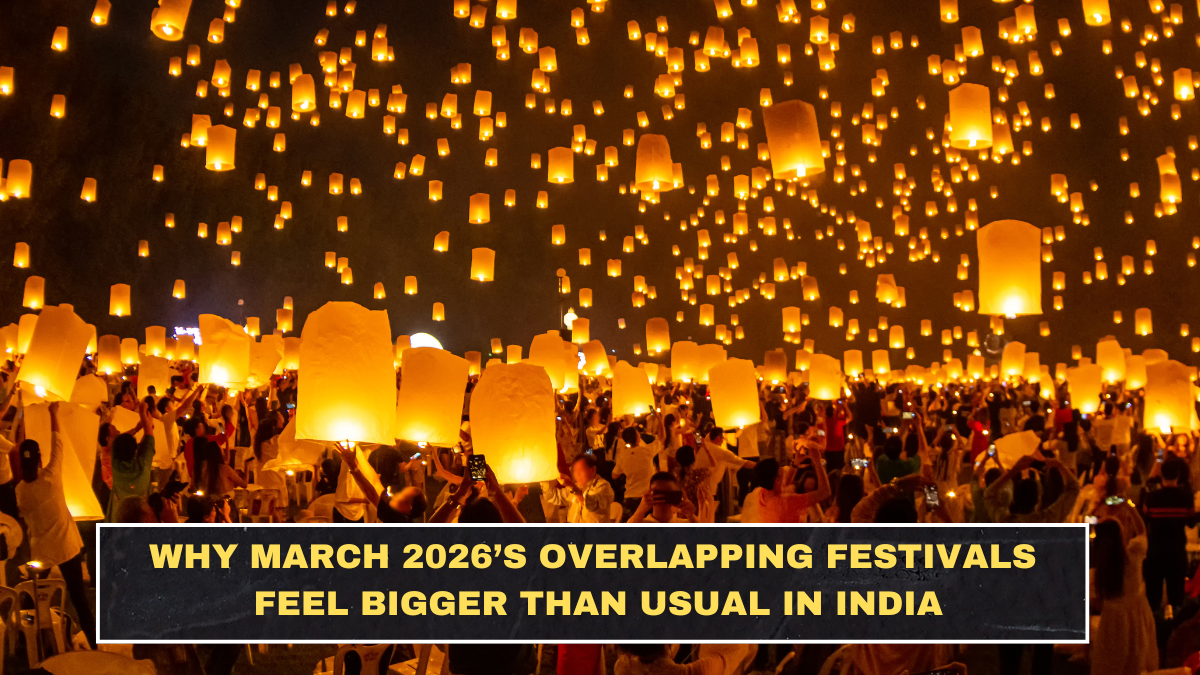
Some months feel festive. March 2026 feels crowded in the strongest possible way. Within a very tight window, India is seeing Holi earlier in the month, then Ugadi and Gudi Padwa on March 19, followed immediately by Jamat Ul-Vida and Eid al-Fitr around March 20, with Chaitra Navratri also starting on March 19 in many calendars. That kind of calendar compression changes how people spend, travel, shop, and plan their lives.
This is why the month feels bigger than usual. It is not just that festivals are happening. It is that several major cultural and religious moments are arriving almost on top of each other, creating one long stretch of emotional, commercial, and logistical activity. Even PIB’s March 2026 release cycle reflects this stacked mood, with separate official greetings for Ugadi, Gudi Padwa, Cheti Chand, and Eid around the same period.
The Calendar Overlap Is Real
Let’s get the dates straight, because vague writing ruins utility. Timeanddate lists Ugadi and Gudi Padwa on Thursday, March 19, 2026, and Jamat Ul-Vida on Friday, March 20, 2026. Drik Panchang also lists Ugadi and Gudi Padwa on March 19, while showing Eid al-Fitr on March 20, 2026, based on its calendar calculations.
That means multiple communities are moving into celebration mode almost simultaneously. In practice, this affects:
- shopping patterns across food, clothing, gifts, and home items
- train and flight demand for family visits
- local events, gatherings, and restaurant traffic
- short-break travel and city movement
- social-media mood and cultural attention
When several festivals bunch together, the country does not behave like it is in a normal week. It behaves like many mini-seasons are running at once.
Why It Changes Spending Behavior
Festival overlap usually pushes households to combine purchases. Instead of planning for one event, families often buy for several needs together: apparel, gifting, sweets, travel bookings, religious items, and home-use products. Mastercard’s India festive-spending analysis says festival periods in India drive increased consumer spending across gifting and special traditions, which lines up with what usually happens when celebrations intensify close together.
The broader consumer backdrop also matters. IBEF says India’s e-commerce sector is expected to reach US$ 163 billion by 2026, showing how much festive demand now spills online as well as offline. That means overlapping festivals are no longer only about local bazaars and neighborhood shopping. They now influence app orders, digital payments, delivery demand, and short-notice convenience spending at scale.
| March 2026 festival cluster | Date | Why it matters |
|---|---|---|
| Holi | March 4, 2026 | Kicks off the month with a major national celebration and early festive spending |
| Ugadi | March 19, 2026 | Important New Year festival in parts of South India; drives family gatherings and shopping |
| Gudi Padwa | March 19, 2026 | Major Maharashtrian New Year celebration; adds parallel festive activity |
| Chaitra Navratri begins | March 19, 2026 | Extends the festive/religious cycle further rather than ending it quickly |
| Jamat Ul-Vida / Eid al-Fitr timing window | March 20, 2026 | Adds major prayer, food, family, and travel activity right after regional New Year festivals |
Why Travel Plans Get More Complicated
This kind of overlap creates pressure on mobility. People traveling for one festival can end up stretching trips to cover another, or they have to choose between destinations and family obligations. Mastercard’s travel materials note that travel demand remains strong and leisure trips are becoming longer on average, while McKinsey has also pointed to more regional trips and steady travel spending in recent consumer behavior. That makes a stacked festival calendar even more likely to trigger short-notice movement.
This is also why hotel prices, intercity routes, and local crowding can feel worse than expected. It is not always because one festival is unusually large. It is because several celebrations are compressing movement into the same window. If you wait too long to plan around a month like this, you are not being relaxed. You are being careless.
Why the Mood Feels More Intense
A packed festival month changes public mood beyond economics. Social feeds get fuller, public greetings multiply, brands rush into campaign mode, and people feel a stronger sense that “something is happening everywhere.” PIB’s releases around March 18 and 20 show how public institutions themselves respond to this stacked atmosphere with multiple festival messages in quick succession.
That intensity matters because cultural attention is limited. When many festivals land together, they reinforce one another in the public imagination instead of each having a quiet, isolated moment. You see more festive decoration, more event-led shopping, more family coordination, and more online content around celebration, food, outfits, and travel. In simple terms, the month feels louder because it actually is.
Why Brands and Businesses Notice This More
Brands do not care about calendar clustering out of cultural sensitivity alone. They care because compressed celebration windows can trigger bursts of demand. Mastercard explicitly notes that festive periods in India increase spending tied to gifting and traditions, while IBEF’s consumer-market updates show the size of India’s festive economy can be huge when demand conditions are supportive.
That means sectors like these usually pay attention fast:
- apparel and ethnic wear
- sweets and packaged foods
- beauty and gifting
- travel and hospitality
- quick commerce and delivery platforms
When festivals overlap, brands have less room for slow campaigns. They need sharper timing, better inventory, and faster consumer targeting.
What March 2026 Really Signals
The bigger takeaway is that India’s festive calendar is now influencing more than rituals. It shapes commerce, travel, digital behavior, and urban rhythm. In a more connected economy, overlapping festivals create ripple effects that move through payments, bookings, retail demand, and social attention almost instantly.
So yes, March 2026 feels bigger than usual. Not because people are imagining it, and not because the internet is overhyping it. It feels bigger because several important festivals are genuinely colliding within days, and modern India amplifies those collisions much faster than before.
Conclusion
March 2026 stands out because it packs Holi, Ugadi, Gudi Padwa, Chaitra Navratri, and the Eid period into one unusually dense stretch. That kind of alignment changes how people shop, travel, gather, and spend attention. The result is a month that feels more active, more emotional, and more commercially charged than a normal festival cycle.
The honest point is this: overlapping festivals are not just a calendar curiosity. They are a real behavior driver in India. If you are a traveler, shopper, business owner, or even just someone trying to plan your month properly, ignoring that overlap is stupid. The crowding is the story.
FAQs
Why are March 2026 festivals being called unusually overlapping in India?
Because major celebrations such as Ugadi, Gudi Padwa, Chaitra Navratri, Jamat Ul-Vida, and Eid al-Fitr are landing within an extremely tight March 19–20 window, while Holi also falls earlier in the same month.
When are Ugadi and Gudi Padwa in 2026?
Both Ugadi and Gudi Padwa fall on Thursday, March 19, 2026, according to major calendar listings.
Is Eid al-Fitr also around the same time in March 2026?
Yes. Drik Panchang lists Eid al-Fitr on March 20, 2026, and Timeanddate lists Jamat Ul-Vida on March 20, showing the Eid period arriving immediately after the March 19 New Year festivals.
Why does festival overlap affect spending and travel?
Because households often combine purchases and trips when several major celebrations come together, which increases demand across retail, gifting, transport, and hospitality.