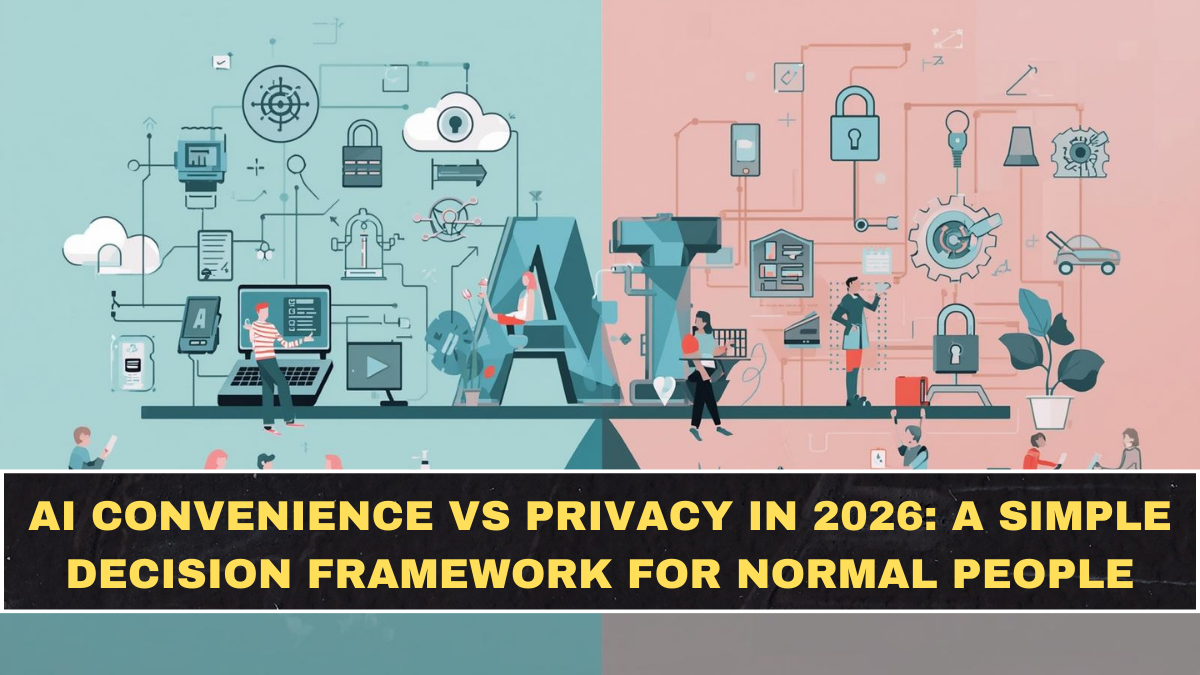
AI convenience in 2026 feels almost irresistible. Phones complete sentences, apps predict what you need next, assistants summarize messages, and platforms automate decisions that once required attention. For most people, these features feel helpful rather than intrusive, especially when they save time during busy days. The problem is not convenience itself, but how quietly it trades away control in exchange for speed.
Privacy discussions often become extreme, pushing users toward all-or-nothing choices that are unrealistic. In reality, most people want a middle ground. They want useful AI features without oversharing data for marginal benefits. In 2026, the smartest approach is not blind trust or total rejection, but a simple decision framework that helps users judge trade-offs calmly.
Why AI Convenience Feels Hard to Resist
AI convenience works because it removes friction. Tasks feel lighter when apps anticipate needs instead of waiting for input.
These systems are designed to reduce mental load, not just effort. Fewer decisions mean less cognitive fatigue.
In 2026, convenience succeeds because it aligns with how overwhelmed people already feel.
What “Privacy Loss” Actually Looks Like Today
Privacy loss is rarely dramatic. It usually happens through gradual permission creep and expanded data reuse.
Data shared for one feature often supports others silently. Location, behavior, and usage patterns connect over time.
In 2026, privacy erosion feels invisible because it happens incrementally.
Why Permission Screens Don’t Tell the Full Story
Permissions explain access, not consequences. Users see what an app can access, not how long data is stored or reused.
Background processing often continues long after initial consent.
Understanding privacy requires looking beyond the permission prompt.
The Convenience Trap: When Small Gains Cost Too Much
Some AI features offer minimal benefit but require deep access. Always-on assistants and behavior profiling fall into this category.
If a feature saves seconds but collects persistent data, the trade-off is rarely worth it.
In 2026, many users overshare for convenience they barely notice.
High-Value Convenience That Justifies Data Sharing
Navigation, fraud detection, and accessibility tools often require data to function meaningfully.
When convenience prevents harm or enables inclusion, sharing data makes sense.
The key is proportionality between benefit and exposure.
Low-Value Convenience That Should Raise Red Flags
Cosmetic personalization and novelty features often request broad access with limited return.
Mood tracking without context or predictive suggestions without accuracy fall short.
These features create data trails without solving real problems.
A Simple Decision Framework for Everyday Use
Ask three questions before enabling AI features. Does this save meaningful time or reduce risk?
Is the data shared reversible or permanent? Can access be limited?
Would the feature still work reasonably with reduced permissions?
Why Data Minimization Beats Blanket Privacy Settings
Turning everything off creates friction and fatigue. Selective control keeps systems usable.
Reducing data scope limits long-term exposure without breaking functionality.
In 2026, privacy success comes from restraint, not restriction.
How Defaults Shape User Behavior
Most users accept default settings. Companies know this and design accordingly.
Defaults often favor data collection over restraint.
Changing defaults is the fastest way to regain control.
The Emotional Side of Privacy Decisions
Privacy choices are emotional, not technical. Fear and convenience pull in opposite directions.
Clear frameworks reduce anxiety by replacing instinct with reasoning.
Confidence comes from understanding trade-offs, not avoiding them.
Teaching AI Systems Through Your Behavior
Every interaction trains systems further. Ignoring this reinforces unwanted patterns.
Intentional use shapes future recommendations and access needs.
In 2026, users are co-authors of their digital experience.
Conclusion: Convenience Is a Choice, Not a Requirement
AI convenience in 2026 is powerful, but it is not mandatory. Every feature represents a choice about how much control to give up for how much benefit. Most users do not need extreme privacy measures or blind acceptance. They need clarity.
By evaluating benefits, limiting permissions, and adjusting defaults, users can enjoy AI assistance without oversharing. Privacy is no longer about hiding; it is about choosing where convenience genuinely improves life and where it quietly costs too much.