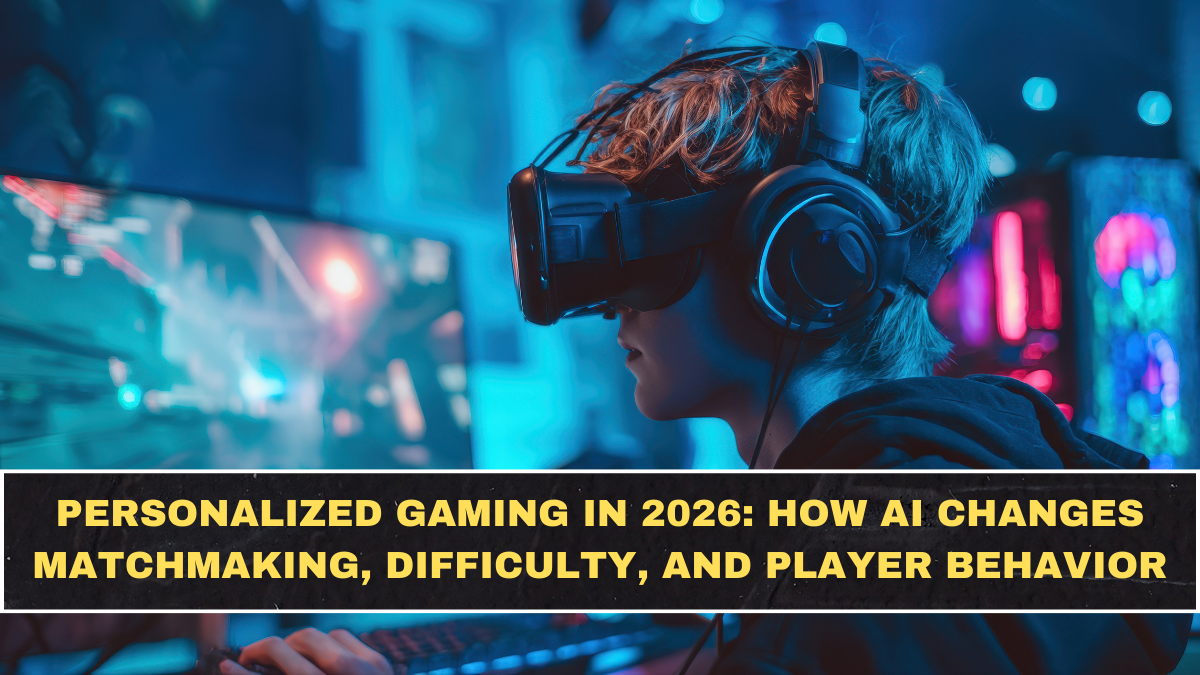
Personalized gaming in 2026 has moved far beyond simple difficulty sliders or ranked tiers. Games now adapt continuously to how players behave, react, and engage over time. From matchmaking that feels uncannily balanced to difficulty systems that shift mid-session, AI-driven personalization is reshaping how games feel on a moment-to-moment basis.
For players, this can feel smoother, fairer, and more engaging. At the same time, it raises questions about transparency, competitiveness, and long-term impact on player habits. Understanding how personalization actually works helps players separate genuine quality improvements from systems designed purely to maximize engagement.
Why Gaming Personalization Accelerated in 2026
Player expectations have changed. Gamers no longer tolerate wildly uneven matches or frustrating difficulty spikes.
AI systems now analyze performance, decision speed, accuracy, and session length in real time. This allows games to respond dynamically instead of relying on static rules.
In 2026, personalization became a response to retention pressure, not just innovation.
AI Matchmaking: What Actually Changed
Matchmaking now considers far more than win–loss ratios. Player behavior, playstyle consistency, and reaction patterns shape matches.
This reduces extreme skill gaps and improves perceived fairness, especially for casual players.
However, it also makes outcomes feel more curated than organic.
Adaptive Difficulty Systems Explained
Adaptive difficulty adjusts challenge based on performance trends rather than single failures.
Games subtly modify enemy behavior, resource availability, or timing without obvious indicators.
When done well, players feel challenged but not punished. When done poorly, it feels manipulative.
Why Players Feel “In the Zone” More Often
Personalization smooths frustration curves. Games detect disengagement signals and intervene early.
This creates longer sessions with fewer rage quits.
In 2026, flow state engineering is a core design goal.
The Fairness Debate in Competitive Games
In competitive modes, personalization becomes controversial. Skill adjustment beyond visible ranks raises trust issues.
Players question whether wins are earned or assisted.
Transparency remains limited, fueling speculation and skepticism.
Addiction Loops and Engagement Tuning
AI systems learn when players are likely to stop playing and adjust rewards accordingly.
This keeps engagement high but risks encouraging unhealthy play patterns.
In 2026, the line between engagement design and manipulation is thin.
Single-Player Games and Personal Storytelling
Personalization shines in single-player experiences. Narrative pacing, quest difficulty, and exploration depth adapt naturally.
Players feel stories “fit” them without explicit customization.
This increases emotional connection without sacrificing control.
Data Collection Behind Personalization
To personalize effectively, games collect granular behavioral data.
This includes play timing, decision patterns, and reaction speed.
Data transparency remains inconsistent across platforms.
What Players Rarely Realize
Personalization is continuous, not fixed. Yesterday’s behavior influences today’s experience.
Small actions accumulate into long-term profile shaping.
In 2026, players are always training the system, whether they know it or not.
How Developers Balance Control and Experience
Designers must decide how much personalization is invisible versus disclosed.
Too much opacity damages trust. Too much visibility breaks immersion.
Successful games balance adaptation with player agency.
What Players Can Do to Stay in Control
Understanding personalization helps players interpret difficulty and outcomes more accurately.
Adjusting play habits resets some adaptive patterns.
Awareness reduces frustration and false assumptions.
Conclusion: Personalization Is Changing How Games Feel
Personalized gaming in 2026 delivers smoother experiences, better pacing, and fewer friction points. When done responsibly, it enhances enjoyment without replacing skill.
However, opacity and engagement tuning introduce ethical questions that players and developers cannot ignore. The future of gaming depends on transparency, balance, and respect for player autonomy as much as technological capability.
FAQs
Does AI matchmaking make games easier?
It makes matches more balanced, not necessarily easier.
Is adaptive difficulty always active?
In many games, yes, but it often operates subtly.
Does personalization affect competitive fairness?
It can, especially when systems are not transparent.
Do single-player games benefit more from personalization?
Yes, because adaptation enhances narrative and pacing.
Is player data required for personalization?
Yes, behavioral data drives adaptive systems.
Can players opt out of personalization?
Options vary by game, but full opt-outs are still rare.