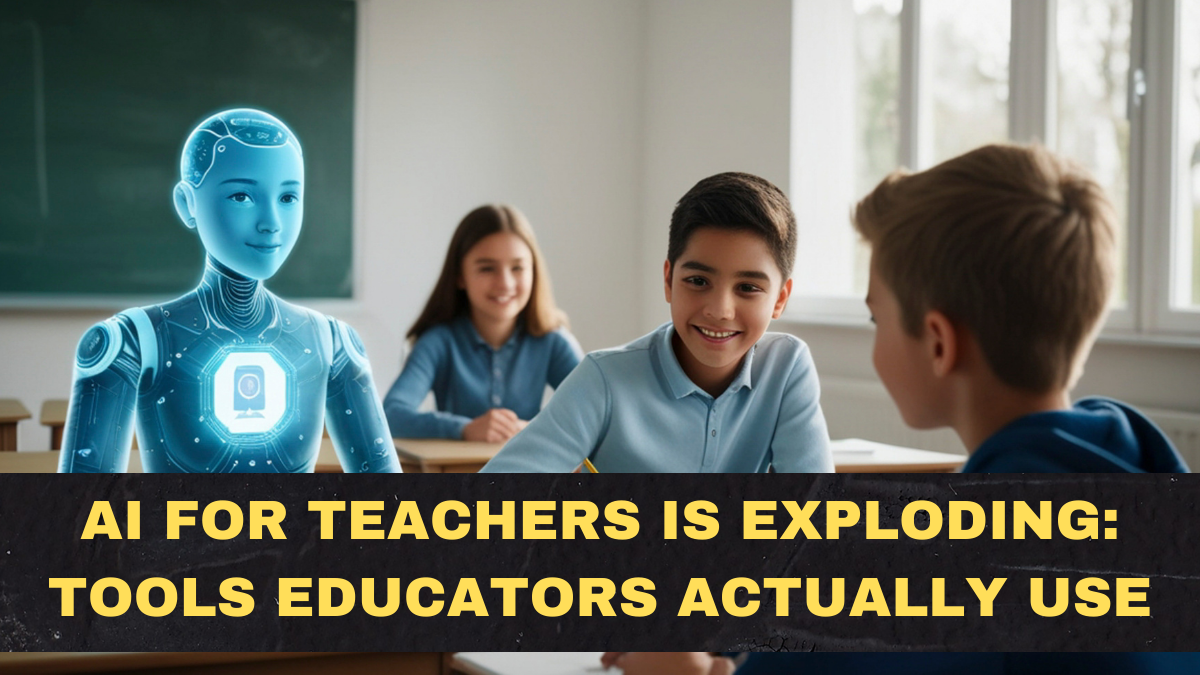
The rapid rise of AI for teachers tools is one of the most transformative shifts happening inside classrooms in 2026. What began as experimental lesson generators and quiz builders has now evolved into a full ecosystem of planning assistants, grading engines, feedback systems, and personalization platforms. Teachers are no longer just using AI occasionally. Many now rely on it daily.
This adoption is not driven by curiosity. It is driven by survival. Workloads are heavier, class sizes are larger, administrative pressure is rising, and expectations for personalization keep increasing. AI is filling the gap between what teachers are expected to deliver and what human time realistically allows.
In 2026, teaching is no longer just pedagogy. It is human instruction supported by machine intelligence.
Why AI Tools Are Being Adopted So Quickly by Teachers
The pressure on educators has reached a breaking point.
Major drivers include:
• Larger class sizes
• More individualized learning requirements
• Increased documentation and reporting
• Digital-first classrooms
• Teacher burnout rates
Teachers now spend:
• More time planning than teaching
• More time grading than mentoring
• More time reporting than innovating
AI tools reduce:
• Preparation time
• Manual grading
• Administrative load
• Repetitive feedback writing
• Content customization effort
This is why lesson planning AI and grading automation are no longer optional experiments. They are becoming core teaching infrastructure.
What AI Tools Teachers Actually Use in 2026
The most adopted tools fall into clear categories.
Planning and content creation:
• Lesson plan generators
• Worksheet builders
• Quiz creators
• Curriculum mapping assistants
Assessment and grading:
• Automated short-answer grading
• Rubric-based scoring tools
• Feedback generation systems
• Assignment triage engines
Classroom support:
• Real-time explanation assistants
• Differentiated content generators
• Language simplification tools
• Visual teaching aid creators
Administrative automation:
• Report writing tools
• Parent communication drafts
• Progress tracking systems
• Intervention flagging tools
These tools save hours per week, which is why adoption continues accelerating.
How Lesson Planning AI Is Changing Teaching Workflows
Planning used to be one of the most time-consuming tasks.
Now teachers use AI to:
• Generate lesson outlines
• Align objectives with standards
• Create differentiated versions
• Build formative assessments
• Design interactive activities
Instead of starting from blank pages, teachers now start from:
• Draft frameworks
• Suggested structures
• Resource bundles
They then:
• Edit
• Personalize
• Adapt
• Improve
AI does not replace pedagogy.
It removes friction from preparation.
This allows teachers to focus more on instruction quality and student engagement.
Why Grading Automation Is the Most Loved Feature
Grading is the biggest pain point.
AI now handles:
• Short-answer scoring
• Essay draft feedback
• Rubric application
• Pattern detection
• Plagiarism flagging
Teachers report:
• Faster turnaround times
• More consistent scoring
• Better formative feedback
• Reduced weekend workload
Importantly, most teachers still:
• Review final scores
• Adjust edge cases
• Add personal comments
Grading automation does not remove teacher judgment.
It removes repetitive mechanical effort.
That distinction is why adoption is strong.
How Personalization Is Becoming Standard Through AI
Differentiation used to be ideal but impractical.
Now AI enables:
• Multiple reading levels per lesson
• Language-adapted content
• Individual practice paths
• Targeted remediation
• Enrichment suggestions
Teachers can now:
• Serve mixed-ability classrooms
• Support struggling students
• Challenge advanced learners
• Track progress more precisely
This transforms classrooms from:
• One-size-fits-all
Into:
• Adaptive learning environments
In 2026, personalization is no longer optional.
It is expected.
Why Teachers Still Distrust Certain AI Features
Despite adoption, serious concerns remain.
Teachers worry about:
• Hallucinated explanations
• Biased grading outputs
• Inaccurate feedback
• Over-reliance by students
• Data privacy risks
The most resisted uses include:
• Fully automated essay grading
• Student behavior prediction
• Emotional assessment tools
• Discipline automation
Educators insist on:
• Human oversight
• Transparency
• Editability
• Explainable outputs
In 2026, trust determines which AI tools survive in education.
How Schools Are Regulating Classroom AI Use
Institutions are building governance frameworks.
Common policies include:
• Approved tool lists
• Student disclosure rules
• AI-assisted work labeling
• Data protection requirements
• Teacher training mandates
Schools now differentiate between:
• Teacher-use AI
• Student-use AI
• Administrative AI
This prevents:
• Academic dishonesty
• Privacy violations
• Over-automation
• Skill erosion
AI adoption in education is now being managed as critical infrastructure, not experimentation.
Why AI Is Changing the Teacher Role, Not Replacing It
The fear of replacement is fading.
AI cannot:
• Build trust
• Manage classrooms
• Inspire curiosity
• Handle emotions
• Adapt to human complexity
Instead, AI handles:
• Drafting
• Sorting
• Scoring
• Formatting
• Repetition
Teachers now spend more time on:
• Coaching
• Mentoring
• Discussion
• Creative teaching
• Relationship building
In 2026, the teacher role is becoming:
• Less clerical
• More strategic
• More human-centered
AI is not replacing teachers.
It is removing everything that distracted them from teaching.
How EdTech Companies Are Competing in This Market
Competition is intense.
Winning platforms offer:
• Curriculum-aligned outputs
• Safe data handling
• Teacher-controlled settings
• LMS integration
• Classroom-friendly UX
They avoid:
• Black-box grading
• Student surveillance
• Overpromising intelligence
• Replacing teacher authority
The most successful tools:
• Integrate quietly
• Save time immediately
• Require minimal training
• Respect pedagogy
In 2026, the best AI tools disappear into workflow rather than dominating it.
Why This Trend Will Permanently Change Education
Structural forces ensure continuation:
• Teacher shortages
• Rising expectations
• Hybrid learning models
• Personalization mandates
• Administrative expansion
Future classrooms will include:
• AI planning assistants
• Automated assessment layers
• Adaptive content engines
• Real-time feedback systems
• Intelligent tutoring support
But teaching will remain:
• Human-led
• Relationship-based
• Emotion-driven
• Ethically guided
AI for teachers tools will become as normal as:
• Projectors
• Whiteboards
• Learning apps
They will simply be part of the profession.
Conclusion
The growth of AI for teachers tools reflects a profound transformation in education in 2026. Faced with rising complexity and pressure, educators are embracing lesson planning AI and grading automation not to replace themselves, but to protect their time, energy, and teaching quality.
When used responsibly, AI is not diminishing education.
It is strengthening it by:
• Reducing burnout
• Improving personalization
• Enhancing feedback
• Restoring focus on students
In this new era, the best classrooms are not run by algorithms.
They are run by teachers empowered by intelligent tools.
And that combination may finally deliver the personalized education systems have promised for decades.
FAQs
What are AI tools for teachers used for most?
Lesson planning, grading automation, feedback generation, personalization, and administrative reporting are the most common uses.
Do teachers trust AI in grading?
Partially. Most teachers use AI as a first pass and still review and adjust scores manually.
Is AI replacing teachers in classrooms?
No. AI supports preparation and assessment but cannot replace instruction, classroom management, or emotional guidance.
Are schools regulating AI use?
Yes. Many schools now approve specific tools and enforce policies around disclosure, privacy, and ethical use.
Will AI become standard in teaching?
Yes. By late 2026, AI-assisted planning and grading are expected to be standard in most digital-first classrooms.
Click here to know more.