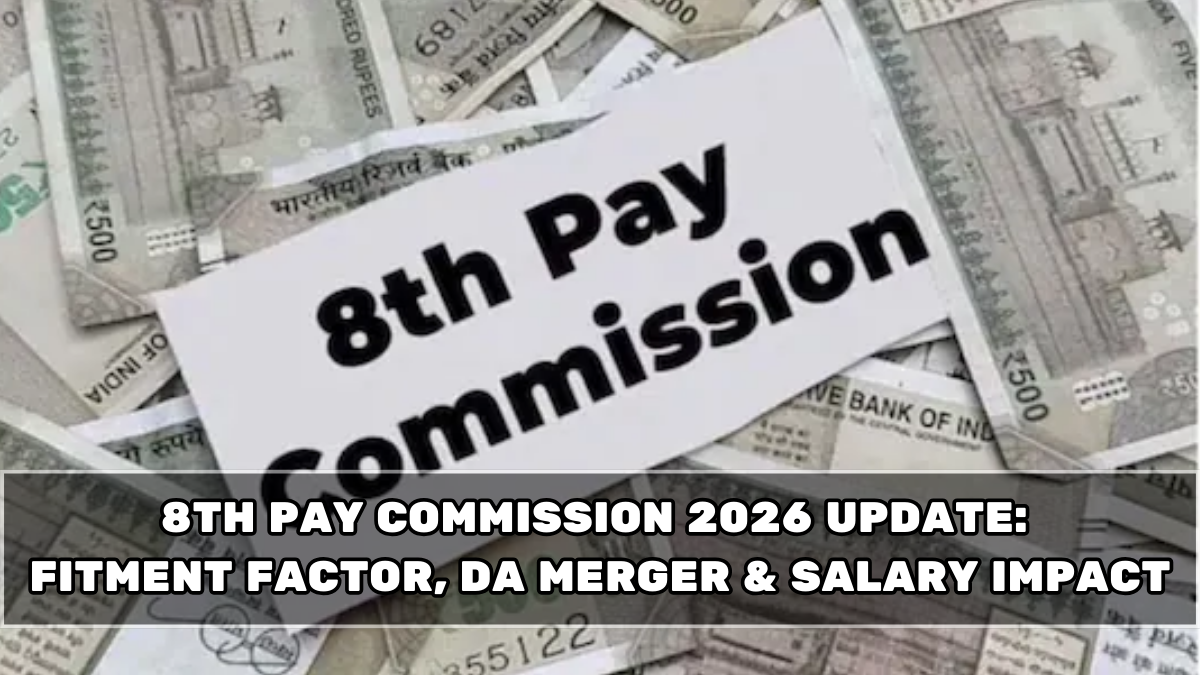
The 8th pay commission update 2026 has become a daily discussion point among central government employees—and for good reason. Salary structure revisions don’t happen often, and when they do, they reshape take-home pay, allowances, and long-term retirement benefits. But much of the noise online mixes assumptions with certainty, creating confusion instead of clarity.
This article explains what is actually being discussed, what remains undecided, how fitment factor and DA merger are viewed, and how employees should estimate impact responsibly—without falling for exaggerated claims.
What Is the 8th Pay Commission
A Pay Commission is constituted to review and recommend changes in pay structure for central government employees and pensioners. The 8th pay commission update 2026 refers to discussions and expectations around the next such revision cycle.
Its role typically includes:
• Reviewing pay matrices
• Rationalising allowances
• Addressing pay compression
• Aligning salaries with inflation
Recommendations are advisory—not automatic.
Who Constitutes a Pay Commission
A Pay Commission is set up by the Government of India and works independently to submit recommendations. Historically, its findings are examined before implementation.
Any final framework related to the 8th pay commission update 2026 will follow administrative and financial approvals before execution.
Why 2026 Is Being Discussed So Actively
Pay Commissions follow long gaps. Employees naturally start recalculating once a cycle matures.
Key reasons behind the buzz:
• Rising cost of living
• DA accumulation over years
• Pay compression at higher levels
• Comparisons with earlier pay revisions
Discussion does not mean confirmation—but it signals expectation.
Understanding the Fitment Factor
The fitment factor is the multiplier used to revise basic pay.
In simple terms:
• Existing basic pay × fitment factor = revised basic
• It impacts allowances linked to basic pay
• Small changes have large cumulative effect
The 8th pay commission update 2026 discussions often revolve around whether the fitment factor will increase meaningfully or remain conservative.
What Is DA Merger and Why It Matters
DA merger refers to combining a portion of Dearness Allowance with basic pay before applying a new structure.
Why employees care:
• DA merger increases basic pay base
• Higher basic improves HRA, TA, pension
• It smoothens inflation impact
However, DA merger is not guaranteed—it depends on policy decisions and fiscal space.
How Salary Impact Is Usually Calculated
Responsible estimation avoids social media hype.
A basic approach:
• Start with current basic pay
• Consider possible DA absorption (if any)
• Apply a reasonable fitment factor range
• Adjust allowances accordingly
The 8th pay commission update 2026 should be evaluated with ranges, not fixed numbers.
What Has NOT Been Confirmed Yet
This clarity matters.
As of now:
• No official notification issued
• No confirmed fitment factor
• No approved DA merger percentage
• No implementation date announced
Anything presented as “final” should be treated cautiously.
How Past Pay Commissions Guide Expectations
Looking backward helps set realistic expectations.
Patterns observed:
• Gradual—not explosive—salary jumps
• Phased implementation
• Allowance rationalisation
• Fiscal balancing
The 8th pay commission update 2026 is likely to follow similar pragmatism.
Who Will Be Most Affected by the 8th CPC
Impact varies by level.
Groups most affected:
• Lower and mid-level employees
• Pensioners with fixed basic
• Employees nearing retirement
• Those with allowance-heavy structure
Understanding your position in the pay matrix matters more than headline numbers.
What Employees Should Do Right Now
Preparation beats speculation.
Smart actions:
• Understand current pay components
• Track DA accumulation
• Avoid financial commitments based on rumours
• Focus on controllable income planning
Assume nothing until officially notified.
Why Overestimating Pay Hikes Is Dangerous
This is where many get stuck.
Risks include:
• Over-borrowing
• Lifestyle inflation
• EMI planning based on assumptions
• Disappointment and financial stress
The 8th pay commission update 2026 should inform planning—not distort it.
How Final Decisions Are Typically Implemented
Once recommendations are accepted:
• Government issues implementation orders
• Pay matrices are notified
• Arrears may or may not apply
• Pension revisions follow
Execution matters as much as recommendations.
Conclusion
The 8th pay commission update 2026 is an important milestone—but not a promise. Fitment factor and DA merger discussions indicate intent, not outcomes. Employees who approach the update with realistic expectations, careful estimation, and disciplined planning will benefit far more than those driven by speculation.
Pay revisions reward patience, not panic.
FAQs
Is the 8th Pay Commission confirmed in 2026?
No official confirmation has been issued yet.
What is the fitment factor in pay commissions?
It’s the multiplier applied to existing basic pay to calculate revised salary.
Will DA be merged under the 8th Pay Commission?
DA merger is discussed historically but not guaranteed.
Should employees plan expenses assuming a big hike?
No. Financial planning should be conservative until official orders are released.
Who benefits the most from a new pay commission?
Lower and mid-level employees usually see proportionally higher impact.